

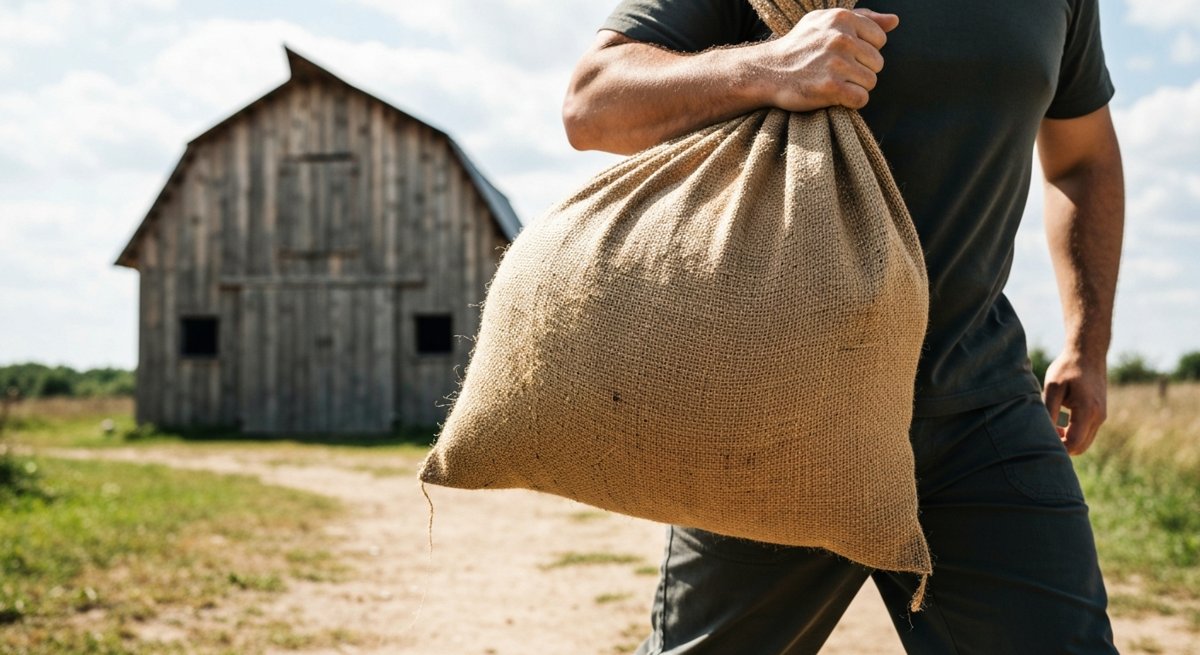
You can bench press 300 pounds and still struggle to carry a 50-pound bag of feed from the truck to the barn. You can run a 5K and still be gassed after hauling a generator uphill. The disconnect isn’t your fitness level — it’s how you train.
If I could only recommend one exercise to someone who works with their hands, spends time outdoors, or just wants to be genuinely useful in a crisis, it would be loaded carries. Not squats. Not deadlifts. Not burpees. Carries.
Here’s why — and exactly how to start doing them today with whatever you have lying around.
What Makes Loaded Carries Different
Most gym exercises isolate muscles. Curls work your biceps. Leg press works your quads. Even compound lifts like squats and deadlifts have a defined start, middle, and end — you lift the weight, then you put it down.
Loaded carries are different because they train your body the way you actually use it: pick something heavy up, hold onto it, and move. That’s it. And in that simplicity is everything.
A single loaded carry session works:
- Grip strength — your hands, forearms, and fingers under sustained load
- Core stability — not crunching, but bracing, which is how your core actually functions in real life
- Shoulder integrity — the rotator cuff and traps working together to keep your shoulders packed and stable
- Hip and ankle stability — maintaining balance under load while walking on uneven ground
- Cardiovascular conditioning — your heart rate will climb fast and stay there
- Mental toughness — there’s no rep count to hide behind; you carry until you can’t
Name another exercise that does all of that. I’ll wait.
The 5 Loaded Carry Variations You Should Know
You don’t need a gym. You don’t even need dumbbells. Here are five variations ranked from easiest to most demanding, with ideas for improvised equipment.
1. The Farmer’s Carry
The classic. Pick up something heavy in each hand and walk. Keep your chest up, shoulders back, and core braced. Don’t let the weight pull you into a lean.
Improvised equipment: 5-gallon buckets filled with sand or gravel (about 50 lbs each), heavy duffel bags, jerry cans filled with water, cinder blocks.
2. The Suitcase Carry
Same as the farmer’s carry, but you only hold weight in one hand. This turns it into an aggressive anti-lateral-flexion exercise — your obliques and deep core muscles have to fire hard to keep you from tilting sideways. This is what actually builds the kind of core strength that prevents back injuries.
Improvised equipment: A single heavy bucket, a loaded backpack held at your side, a sandbag, a propane tank.
3. The Bear Hug Carry
Wrap your arms around something heavy and walk. This murders your upper back, biceps, and core. It also trains the exact movement pattern you use carrying feed bags, hay bales, or an injured person.
Improvised equipment: A heavy sandbag, a large rock, a bag of concrete mix (don’t open it — those 80-lb bags are perfect), a keg.
4. The Overhead Carry
Press something overhead and walk with it locked out. This is shoulder stability on hard mode. Start light — seriously. Even 25 pounds overhead for 100 yards will expose weaknesses you didn’t know you had.
Improvised equipment: A sandbag, a log, a heavy toolbox, a water jug. One hand or two — both work.
5. The Ruck
Load up a backpack and walk. This is the endurance version of loaded carries. Less peak intensity, more sustained demand. Military units have used this for centuries because it works. A 45-minute ruck with 30-40 pounds will humble anyone who thinks walking isn’t exercise.
Improvised equipment: Any backpack loaded with books, bricks, sand bags, or water bottles. A purpose-built ruck plate is nice but not necessary.
The Starter Program: 3 Weeks to a Stronger Everything
Here’s a dead-simple program. Three sessions per week. Each session takes 20-30 minutes. No gym required.
Week 1 — Build the Base
- Farmer’s carry: 4 x 40 yards (rest 60-90 seconds between sets)
- Suitcase carry: 3 x 30 yards per side
- Use a weight that’s challenging but lets you keep good posture
Week 2 — Add Variety
- Farmer’s carry: 4 x 50 yards
- Bear hug carry: 3 x 30 yards
- Overhead carry: 3 x 25 yards per arm (go light)
Week 3 — Test Yourself
- Farmer’s carry medley: carry 60 yards, set down, bear hug carry back 60 yards. Rest 2 min. Repeat 3 times.
- Saturday: Load a pack with 30 lbs and ruck for 30-45 minutes. Walk your neighborhood, walk a trail — just walk.
Common Mistakes That Kill Your Progress
Going too heavy too fast. Your grip will be the first thing to fail, and that’s fine — that’s what you’re training. But if you can’t walk with your shoulders back and your core braced, the weight is too heavy. Drop it down. Form matters here as much as anywhere.
Short-arming the distance. A 15-yard farmer’s carry is basically just a heavy hold. You need at least 30-40 yards to get the training effect of walking under load. If space is tight, do laps.
Holding your breath. Breathe. Short, rhythmic breaths through your nose. Your core should stay braced while you breathe — that’s the whole skill you’re developing.
Only training one variation. Each carry variation loads your body differently. The farmer’s carry builds grip and traps. The suitcase carry builds obliques and anti-rotation. The bear hug builds upper back endurance. Rotate through them.
Why This Matters Beyond the Gym
I’ll be honest — I think the fitness industry has overcomplicated everything. People are doing cable crossovers and Smith machine quarter-squats while they can’t carry their groceries in one trip without their forearms cramping.
Loaded carries build the kind of strength that makes you capable. Capable of hauling a downed tree off a trail. Capable of carrying your kid and a 40-pound pack at the same time. Capable of moving supplies in an emergency without breaking down after the second trip. That’s not gym strength — that’s useful strength.
And here’s the thing nobody talks about: carries build mental resilience in a way that sets and reps don’t. There’s something about holding heavy weight while your grip screams and your lungs burn and your only job is to keep walking that rewires your relationship with discomfort. You learn to exist in the suck. That skill transfers to everything.
The Challenge
Here’s what I want you to do this week: find two heavy things in your garage, your barn, or your yard. Fill two 5-gallon buckets with gravel if you have to. Then walk with them for as far as you can without setting them down.
Measure that distance. Write it down.
Next week, beat it.
That’s it. No app. No program. No subscription. Just you and something heavy and a direction to walk. Do that three times a week for a month and tell me your life hasn’t changed.
Loaded carries are the foundation of real-world fitness. Start simple, stay consistent, and stop overcomplicating it.