Your grip is the first thing to fail. On the pull-up bar, carrying groceries from the truck, dragging a deer out of the woods, holding a wrench on a stubborn bolt — when your hands give out, you’re done. Doesn’t matter how strong your back or legs are.
And yet almost nobody trains grip directly. They’ll curl 40-pound dumbbells three times a week but can’t hang from a bar for 60 seconds. That’s a problem — especially if you’re someone who actually uses their hands for real work.
Here’s the good news: you don’t need a single piece of equipment to build serious grip strength. Everything you need is already around you.
Why Grip Strength Actually Matters
Before we get into the how, let’s talk about why this isn’t just gym vanity.
Grip strength is one of the most reliable predictors of overall health and longevity. That’s not bro-science — it’s published research. A 2015 Lancet study following 140,000 people across 17 countries found that grip strength was a stronger predictor of cardiovascular death than systolic blood pressure. Let that sink in.
Beyond the medical data, practical grip strength means:
- Better performance on every pull exercise — deadlifts, rows, pull-ups all improve when grip isn’t the bottleneck
- Injury prevention — a stronger grip means stronger forearms, wrists, and connective tissue
- Real-world utility — chopping wood, carrying buckets, climbing, working on engines, handling tools under load
- Self-defense capability — controlling someone starts with your hands
If you train outdoors, work with your hands, or just want to be harder to kill — grip is foundational.
The Three Types of Grip You Need to Train
Most people think “grip” is just squeezing. It’s not. There are three distinct grip patterns, and you need all of them:
1. Crush Grip
This is the handshake grip — closing your fingers against resistance. It’s what people usually think of when they hear “grip strength.” You use it turning wrenches, squeezing handles, and holding anything heavy with a full wrap.
2. Pinch Grip
Thumb opposed to fingers, like pinching a thick book between your thumb and fingertips. Crucial for holding odd-shaped objects, plates, and anything you can’t wrap your hand around.
3. Support Grip (Hang / Carry)
How long can you just hold something? This is endurance grip — dead hangs, loaded carries, holding a heavy bag. It’s arguably the most practical of the three and the easiest to train with zero equipment.
8 Zero-Equipment Grip Exercises You Can Start Today
No grippers, no dumbbells, no excuses. Here’s what to do with what you have:
1. Dead Hangs (Support Grip)
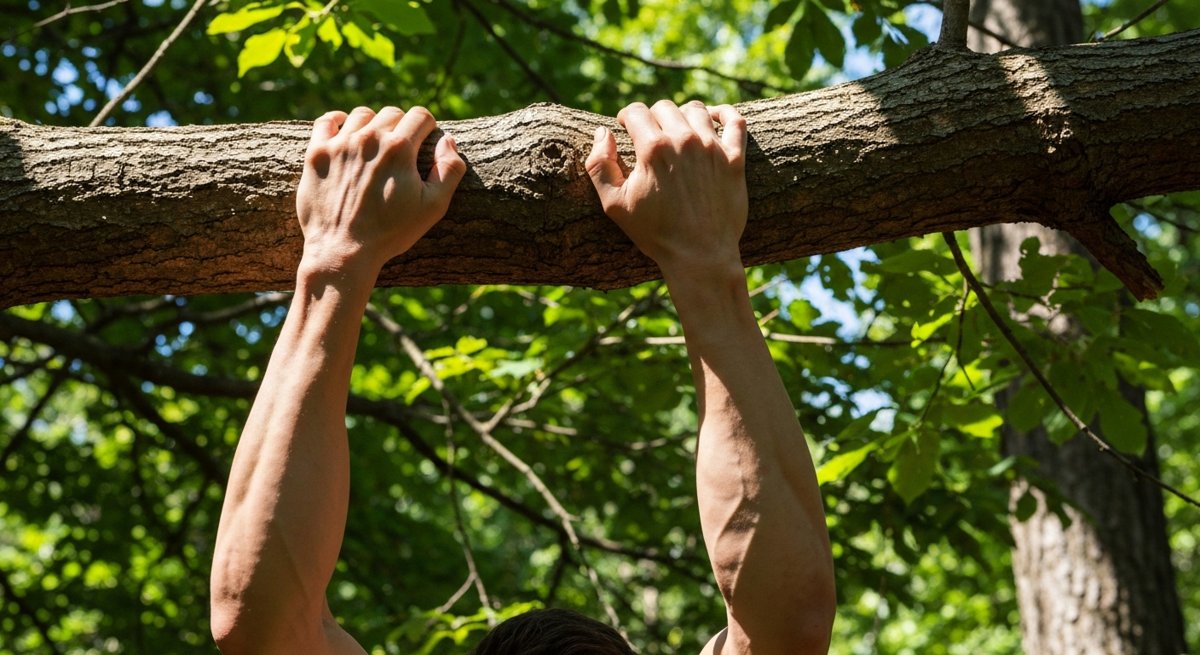
Find anything you can hang from — a tree branch, a door frame pull-up bar, a beam in your garage, a playground bar. Hang with straight arms, shoulders engaged (not just dangling from your joints), and hold as long as you can.
Target: 3 sets, max hold. Work toward 90 seconds. When you hit that, try single-arm hangs.
2. Towel Hangs (Crush + Support)
Throw a towel over your hanging bar and grip the towel instead of the bar. This forces you to squeeze to stay up — dramatically harder than a standard hang. This is the single best bang-for-your-buck grip exercise, period.
Target: 3 sets, max hold. If you can do 45 seconds, you’ve got strong hands.
3. Fingertip Push-Ups (Crush + Pinch)
Standard push-ups but on your fingertips instead of your palms. Start on your knees if needed — this is harder than it sounds. Keep fingers spread wide and slightly arched, not flat.
Target: 3 sets of 8-12. Build slowly — your finger tendons need time to adapt.
4. Bucket Carries (Support Grip)
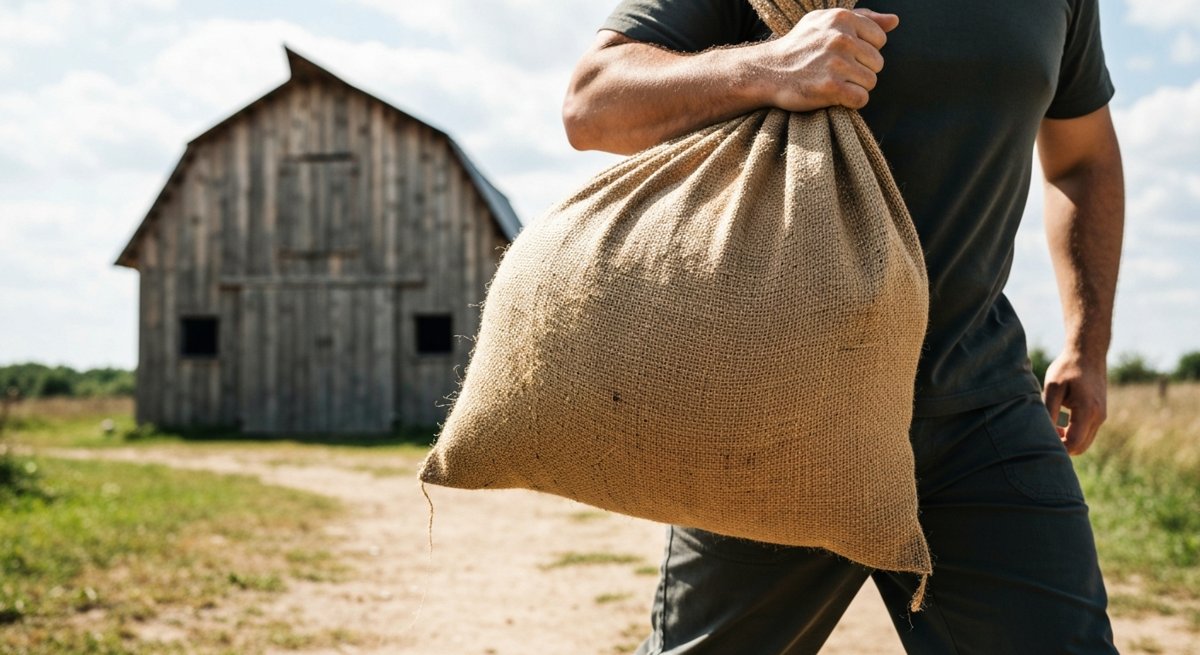
Fill two 5-gallon buckets with water, dirt, sand, or rocks. Pick them up and walk. That’s it. This is a farmer’s carry without the fancy handles — and the bucket rim is actually harder to hold because it’s thin and awkward.
Target: 3 walks of 100-200 feet. Add weight as it gets easy.
5. Rock Pinch Holds (Pinch Grip)
Grab two flat-ish rocks — something you can pinch between thumb and fingers but can’t wrap your hand around. Hold them at your sides and walk, or just hold for time standing still. This is old-school strongman training and it works.
Target: 3 sets, max hold per hand. Find progressively heavier or smoother rocks.
6. Hand Squeezes (Crush Grip)
No gripper? No problem. Take a tennis ball, a rolled-up sock, or even a wadded-up newspaper and squeeze it as hard as you can for reps. Hold the squeeze at peak contraction for 3-5 seconds each rep. Simple, boring, effective.
Target: 3 sets of 15-20 hard squeezes per hand.
7. Finger Extensions (Rehab + Balance)
Wrap a rubber band (or a few) around all five fingertips and spread your fingers against the resistance. This trains the extensors — the opposing muscles. If you only train crush grip without extensions, you’re asking for elbow problems down the line.
Target: 3 sets of 20-25 per hand. Light, high-rep work.
8. Wrist Rotations Under Load (Wrist + Forearm)
Hold anything heavy with one hand — a full water jug, a heavy book, a rock. With arm extended, slowly rotate your wrist clockwise and counterclockwise. This builds the rotational forearm strength that most grip programs miss entirely.
Target: 3 sets of 10 rotations each direction per hand.
A Simple Weekly Plan
You don’t need to do all eight every day. Here’s how to structure it:
| Day | Focus | Exercises |
|---|---|---|
| Mon / Thu | Support + Crush | Dead hangs, towel hangs, hand squeezes |
| Tue / Fri | Pinch + Wrist | Rock pinch holds, fingertip push-ups, wrist rotations |
| Wed / Sat | Loaded Carry | Bucket carries, finger extensions (recovery) |
| Sun | Rest | Light finger extensions only if hands feel tight |
Total time commitment: about 10-15 minutes per session, tacked onto whatever else you’re already doing. This isn’t a separate workout — it’s an add-on.
Common Mistakes to Avoid
- Going too hard too fast. Your finger tendons don’t have the blood supply that muscles do. They adapt slowly. If you jump into fingertip push-ups and max towel hangs on day one, you’ll end up with inflamed tendons for weeks. Build up over 2-3 weeks.
- Ignoring the extensors. If you only train crushing and never train opening, you’ll develop imbalances that lead to tennis elbow or golfer’s elbow. Do the rubber band extensions. They take 90 seconds.
- Only training one grip type. All crush, no pinch means you can squeeze a barbell but can’t hold a cinder block. Train all three patterns.
- Using straps as a crutch. Lifting straps have their place for max-effort deadlifts, but if you strap up for every set of rows, your grip never has to keep up. Ditch the straps for everything except your heaviest work sets.
The Challenge
Here’s your homework: go hang from something right now. A tree branch, a door frame, a beam — whatever you’ve got. Time yourself. That’s your baseline.
Follow the plan above for 30 days, then test again. I’d bet good money you add at least 30 seconds to your hang time, and you’ll notice the difference everywhere — in the gym, at work, around the property.
Grip strength is one of those things that separates people who train for show from people who train to be useful. You don’t need expensive equipment or a gym membership. You need a branch, a bucket, a towel, and the willingness to hang on when your hands are screaming at you to let go.
Your hands are your most important tools. Train them like it.