Safe Appetite Control: What Actually Works (Supplements, Strategies, and the Science)

Willpower is not your problem. If you’ve ever crushed a “clean” lunch and found yourself elbow-deep in a bag of chips 90 minutes later, you don’t have a character flaw — you have a biology problem. Hunger is driven by hormones, blood sugar, sleep, and what you ate last, not by how disciplined you feel. The good news: those are all levers you can pull. Here’s what actually moves the needle, and what’s just expensive urine.

First, Know What You’re Fighting

Two hormones run the show. Ghrelin is the “I’m hungry” signal — it spikes before meals and when you’re short on sleep. Leptin is the “I’m full, stop eating” signal. When you’re tired, stressed, or eating fast-digesting junk, ghrelin goes up and leptin gets ignored. That’s the whole game. Every real appetite strategy below works by turning ghrelin down or making leptin louder. Anything that doesn’t touch those levers is selling you a story.

The Three Things That Actually Work

1. Eat Protein First, and Eat Enough of It

Protein is the most filling macronutrient by a wide margin. It blunts ghrelin, slows digestion, and costs your body energy just to break down. The research is boringly consistent: front-load protein and you eat less for the rest of the day without trying. My rule of thumb — get 30–40 grams at breakfast. Not a granola bar. Eggs, Greek yogurt, cottage cheese, or a shake.

If mornings are chaos, a shake is the path of least resistance, and that’s the whole point — you want the easy choice to also be the right one. A scoop of Optimum Nutrition Gold Standard 100% Whey gets you ~24g in 30 seconds, and honestly it’s the whey I keep in my own cabinet because it actually mixes instead of clumping. Pair it with a BlenderBottle Classic V2 Shaker so there’s zero excuse on a busy morning. Opinion: protein powder is the single most useful “supplement” most people can buy, because it’s just food you were too busy to cook.

2. Add Volume With Fiber

Fiber fills your stomach, feeds your gut bacteria, and slows the sugar spike-and-crash that makes you hungry again an hour later. Most Americans get about half the fiber they should. Fix that with food first: beans, lentils, oats, berries, and a mountain of vegetables at every meal. Vegetables are the cheat code — they take up enormous stomach real estate for almost no calories.

If you want a supplement lever, psyllium husk or glucomannan (konjac fiber) both have real data behind them for appetite. Glucomannan absorbs water and expands in your stomach; taken with a big glass of water 20–30 minutes before a meal, it takes the edge off. It’s not magic — it’s a physics trick — but it’s a cheap, safe one. Just don’t expect a pill to outrun a bad diet.

3. Sleep, Because Tired People Eat More

This is the one nobody wants to hear. One bad night of sleep raises ghrelin, lowers leptin, and torpedoes your impulse control — studies consistently show sleep-deprived people eat 300–500 extra calories the next day and reach for junk, not broccoli. You cannot out-discipline a sleep deficit. If your appetite is out of control, audit your sleep before you buy a single supplement. Seven-plus hours does more for your waistline than any pill on this list.

The Free Habits That Punch Above Their Weight

  • Drink a glass of water first. Thirst masquerades as hunger constantly. Water before a meal also modestly reduces how much you eat. Cheapest tool you own.
  • Slow down. It takes ~20 minutes for fullness signals to reach your brain. Eat fast and you’ll blow past “full” before you feel it. Put the fork down between bites — sounds dumb, works.
  • Pause 10 minutes before a second helping. Most “I’m still hungry” moments evaporate if you just wait. If you’re still hungry after 10 minutes, eat — usually you won’t be.
  • Don’t drink your calories. Soda, juice, and sugary coffee drinks don’t trigger fullness at all. You’ll eat the same amount of food on top of them.

Supplements: What Has Data vs. What’s Snake Oil

Has real evidence: protein, soluble fiber (psyllium, glucomannan), and caffeine (a modest, short-term appetite suppressant — a black coffee before a meal is a legit tool). Berberine and blood-sugar-stabilizing approaches can help some people with cravings, but that’s a talk-to-your-doctor conversation, not a gas-station-pill one.

Save your money: garcinia cambogia, raspberry ketones, “fat burner” blends, and 90% of the stuff with a shirtless guy on the label. The research on them ranges from “underwhelming” to “flatly doesn’t work,” and some are just caffeine with a 400% markup. My honest take: if a product promises to “melt fat” or “crush cravings” with a proprietary blend, the only thing shrinking is your wallet.

And yes — the GLP-1 drugs (Ozempic, Wegovy, etc.) genuinely crush appetite by mimicking a fullness hormone. They work. But that’s a prescription and a doctor’s call, not a supplement, and they come with real trade-offs. Out of scope for a grocery-store fix.

Make the Right Choice the Default (Meal Prep)

Here’s the part that ties it all together: appetite control isn’t a moment of willpower, it’s a system you set up in advance. When there’s a protein-heavy meal ready to grab, you don’t negotiate with a vending machine. Prep hits your three levers at once — protein, fiber, and not-being-a-tired-hangry-mess at 6 p.m.

A dead-simple Sunday: cook a batch of chicken or ground beef, a pot of rice or beans, and roast two trays of vegetables. Portion it. Keep boiled eggs and Greek yogurt in the fridge for grab-and-go protein. Stash a shaker and a bag of whey at work. That’s it. You’ve now made the hungry-3-p.m. version of yourself choose between “good food that’s already here” and “nothing” — and that’s a fight future-you actually wins.

The Takeaway

Stop treating hunger like a willpower test you keep failing. It’s a system. Hit protein first, add fiber volume, protect your sleep, and set up your environment so the easy choice is the good one. Do that and “appetite control” stops being a daily battle and becomes background noise.

Your challenge this week: nail 30 grams of protein at breakfast, every single day, for seven days. Nothing else. Just that one lever. Then notice how much quieter your afternoon cravings get. If that’s the only thing you take from this post, it’ll still be the highest-leverage change most people can make.
How Fat Cells Work: The Science of Fat Growth, Storage, and Why Volume Eating Wins

Understanding how your body stores fat changes how you fight it. This isn’t a diet plan — it’s the operating manual your body didn’t come with.

Your Fat Cells Are Balloons, Not Boxes

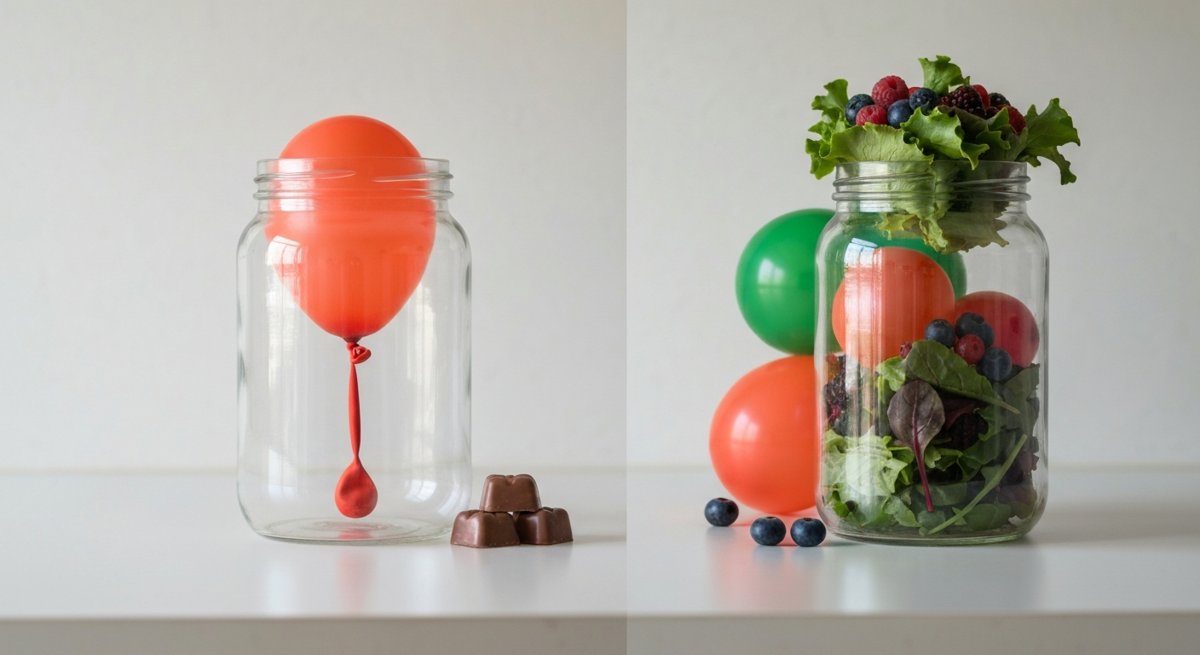
Most people think of fat as a substance you “burn off.” It’s more accurate to think of fat cells as billions of tiny balloons. When you eat more than you use, each balloon inflates with triglycerides. When you eat less than you use, each balloon deflates. The balloons themselves don’t go away — they just change size.

An average adult has roughly 30 billion fat cells. Someone who has been significantly overweight can have 100 billion or more. That difference matters, and we’ll get to why.

Phase 1: Hypertrophy — Cells Get Bigger

When you start gaining weight, your existing fat cells absorb more triglycerides and expand. A single fat cell can swell to roughly 4-6 times its lean volume. This is the primary mechanism behind most weight gain.

The good news: this is fully reversible. Eat less than you burn, and these cells shrink right back down. No permanent damage done.

Phase 2: Hyperplasia — New Cells Are Born

Here’s where it gets serious. When your existing fat cells hit their storage limit — roughly 0.7-0.8 micrograms of lipid per cell — they send out chemical distress signals. These signals trigger stem cells (pre-adipocytes) to differentiate into brand new fat cells.

This typically kicks in when men exceed roughly 25-30% body fat, though genetics, fat distribution, and how long you’ve been at that weight all play a role.

The critical part: once new fat cells are created, you cannot lose them through diet or exercise. You can only shrink them. They sit there, empty and waiting, sending “fill me” signals that make weight regain easier. This is a major reason why people who were once significantly overweight have a harder time maintaining weight loss than people who were never heavy.

The Numbers — Where Are You?

Here’s a rough framework for men (women carry ~8-10% more body fat at equivalent fitness levels):

  • 15-20% body fat: Healthy range. Your existing cells are comfortably filled, no hyperplasia risk. Weight loss from here is straightforward — you’re just deflating balloons.
  • 20-25% body fat: Overfilled but manageable. Still mostly hypertrophy. Cells are stretched but not maxed out. This is the most responsive range for diet changes.
  • 25-30% body fat: Approaching the threshold. Cells are near capacity. The longer you stay here, the higher the risk of triggering new cell creation. This is the “act now” zone.
  • 30%+ body fat: Hyperplasia is likely active, especially if you’ve been here for months or years. Weight loss is still absolutely possible, but your body is building infrastructure that will fight you on the way back down.

Quick estimate: if you know your lean target weight (what you’d weigh at 15% body fat), subtract that from your current weight, divide by current weight, and multiply by 100. That’s your approximate body fat percentage. It’s rough, but it gets you in the right zone.

What This Means for Your Diet

The science points to one clear strategy: don’t stay overfilled for long periods. Brief spikes in weight (holidays, vacations, stressful months) are fine — your cells inflate and deflate without creating new ones. It’s the sustained, months-long surplus that triggers hyperplasia.

But “eat less” is useless advice if you’re hungry all the time. The real answer is volume eating — foods that fill your stomach and keep you satisfied while delivering fewer calories per bite.

Volume Eating: Big Plates, Small Calories

Your stomach doesn’t count calories. It measures volume and weight. Stretch receptors in your stomach wall tell your brain “I’m full” based on how much physical space the food takes up — not how many calories it contains. This is the cheat code.

The High-Volume Playbook

  • Cruciferous vegetables: Broccoli, cauliflower, Brussels sprouts, cabbage. A full pound of broccoli is only 150 calories but fills an entire plate. Roast with garlic and olive oil for flavor without going overboard.
  • Leafy greens: Spinach, kale, arugula. An enormous salad bowl is 30-50 calories before dressing. Use vinaigrette instead of ranch and you stay under 150 for a meal-sized salad.
  • Lean proteins: Chicken breast, turkey, white fish, shrimp, egg whites. High satiety, moderate calories. 8 oz of chicken breast is ~280 calories and keeps you full for hours.
  • Potatoes (yes, potatoes): The most satiating food ever measured on the Satiety Index. A large baked potato is ~280 calories and will keep you fuller than almost anything else you can eat. Skip the butter and sour cream — use Greek yogurt and hot sauce instead.
  • Soups and stews: Water adds volume without calories. A giant bowl of chicken vegetable soup can be 200-300 calories and feel like a feast. This is the ultimate meal-prep food.
  • Berries: Strawberries, blueberries, raspberries. A full cup of strawberries is 50 calories. Compare that to a banana at 100+ or grapes at 100+.
  • Greek yogurt: High protein, thick texture, very satiating. 200g of non-fat Greek yogurt is ~130 calories with 20g of protein.
  • Popcorn (air-popped): 3 cups of air-popped popcorn is 90 calories. That’s a large bowl for the calorie cost of a single handful of chips.

The Calorie Density Trick

Think in terms of calories per pound:

  • Vegetables: 60-200 cal/lb
  • Fruits: 200-350 cal/lb
  • Potatoes, rice, beans: 400-600 cal/lb
  • Lean meat, fish: 500-700 cal/lb
  • Bread, pasta: 1,200-1,500 cal/lb
  • Cheese: 1,600-1,800 cal/lb
  • Nuts: 2,500-3,000 cal/lb
  • Oils, butter: 4,000 cal/lb

Build your plates from the top of this list. The lower you go, the smaller your portions need to be.

Meal Prep That Actually Works

Volume eating is perfect for meal prep because the base ingredients are cheap, keep well, and cook in bulk.

  • Sunday protein cook: Grill or bake 3-4 lbs of chicken breast, portion into containers. Season differently (lemon herb, cajun, teriyaki) to avoid monotony.
  • Big-batch soups: Make a pot of chicken vegetable, turkey chili, or lentil soup. Portions into 5 containers. Reheats perfectly all week.
  • Roasted vegetable trays: Sheet-pan roast a mix of broccoli, bell peppers, zucchini, and sweet potato. 400°F, 25 minutes. Makes 4-5 side portions.
  • Overnight oats: Rolled oats, Greek yogurt, berries, splash of almond milk. Prep 5 jars Sunday night. Grab and go all week. ~300 calories per jar with 20g+ protein.
  • Egg muffins: Whisk eggs with spinach, peppers, turkey sausage. Pour into muffin tins, bake at 375°F for 20 minutes. 12 muffins = 3-4 days of grab-and-go breakfasts at ~70 calories each.

The key to sustainable meal prep: cook the protein and base vegetables in bulk, vary the sauces and seasonings daily. Same chicken breast tastes completely different with salsa verde vs. mustard vs. soy-ginger glaze.

For more meal prep ideas, recipes, and detailed macros, check out our growing recipe collection — we’ll be adding new volume-friendly recipes regularly.


The science is clear: your fat cells are permanent residents, but their size is negotiable. Fill your plates with volume, keep your cells from maxing out, and the biology works in your favor.

— BaseCampGoods
Nutrition & Meal Prep · basecampgoods.com