Situational Awareness: How to See Trouble Before It Sees You

Situational awareness has a marketing problem. Search the term and you get a wall of guys in wraparound sunglasses telling you to keep your head on a swivel, plus a $400 course that will teach you to identify a threat at 200 yards. It’s mostly theater, and it’s exhausting — nobody can live in a state of low-grade dread, so most people try it for a week and quit.

Here’s the actual truth: situational awareness is not a mood. It’s a set of small, boring habits that cost you almost nothing and run in the background. Done right, you’re not more anxious — you’re less anxious, because you’ve replaced vague unease with specific information. This post gives you the mental model and five drills you can start today.

The Only Concept That Matters: Baseline and Anomaly

Forget threat detection for a second. You cannot spot a threat if you don’t know what normal looks like. So the whole skill reduces to two steps:

  • Establish the baseline. What is normal for this place, at this hour? A gas station at 7 a.m. has a rhythm — people move with purpose, pump, pay, leave. A park at 3 p.m. on a Saturday has a different one.
  • Notice the anomaly. Something that doesn’t fit the rhythm. Not something scary — something out of place. A guy in a parka in August. A car idling in a lot where every other car is parked and empty. Someone standing still while everyone else flows.

That’s it. Anomalies are almost never threats — 99% of the time it’s a guy waiting on his wife. But threats are always anomalies, so if you’re tracking anomalies you catch the real thing early enough to matter. And “early enough to matter” is the entire game.

Cooper’s Color Code, Honestly

You’ll run into Jeff Cooper’s color code everywhere in this space. The short version:

  • White — switched off. Phone in your face, headphones in, zero input. This is where most people live in public.
  • Yellow — relaxed alert. You’re aware, not alarmed. Head up, eyes moving, no specific concern.
  • Orange — you’ve identified a specific anomaly and you’re watching it. You start forming a simple plan.
  • Red — the plan executes.

My honest take: the color code is a decent shorthand and a terrible doctrine. People treat it like a ladder they should be climbing. It isn’t. The only real instruction in the whole system is stop living in White when you’re out in the world, and Yellow is not a strain — it’s just what your grandfather called paying attention. Everything above Yellow should be rare and short.

Five Drills You Can Start Today

1. The Baseline Drill (5 minutes, once a day)

Sit somewhere public — a coffee shop, a bench, your truck in a parking lot. Spend five minutes silently answering: What’s the flow of traffic here, on foot and in cars? Who’s working and who’s passing through? What’s the noise level? What would stand out? Then leave. You’re not hunting anybody. You’re training the part of your brain that builds baselines, so it does it automatically later.

2. Exits First (10 seconds, every room)

Walk into any building — restaurant, store, gym — and locate two ways out before you sit down. The one you came in and one other. Kitchens have back doors. Big-box stores have loading docks and fire exits. This takes ten seconds and pays off in fires, medical events, and weather far more often than in violence. Then pick a seat where your back isn’t to the main entrance. Not because you’re expecting trouble — because it costs you nothing.

3. The Phone Rule (the big one)

If I could get you to change exactly one thing, it’s this: no phone and no headphones in transitional spaces. Parking lots, stairwells, ATMs, gas pumps, the walk from the building to your car. Those transitions are where the overwhelming share of opportunistic crime happens, because that’s where people are distracted, loaded down, and briefly isolated.

Phone goes in the pocket when you leave the door and comes out when you’re in the car with the doors locked. That’s the whole rule. It outperforms every tactical skill on this list, and it’s free.

4. Describe the Person (30 seconds, a few times a week)

Pick someone in your environment. Look away. Now describe them: height, build, hair, top, bottoms, shoes, anything they’re carrying. Then check yourself. Most people fail badly the first dozen times — they remember a vibe, not a description. This drill matters for two reasons: it sharpens what you actually register, and if you ever need to give a description to a dispatcher, “average guy in a dark shirt” helps nobody. Shoes, by the way, are the detail people change least and observers notice least.

5. The 360 Pause (3 seconds, every vehicle approach)

Before you unlock your car, stop and take one full look around it — including the back seat, and including under it if you’re the thorough type. Before you back out, check who’s moving in the lot. When you park, back into the spot so you can leave forward. Parking lots are the highest-risk ordinary place most of us go, and three seconds of scanning restores most of your options.

What Actually Precedes Trouble

Predatory behavior has a shape. You don’t need a course to learn it — you need to know what to file as an anomaly:

  • The target glance. Someone looks at you, looks away, and looks back. Especially if they check your surroundings rather than their own.
  • Closing distance without purpose. The single most reliable indicator. Normal people move toward a destination. Watch anyone whose destination appears to be you.
  • The interview. An unsolicited approach with a question — directions, the time, a light, a hard-luck story. It’s a test of whether you’ll engage and comply. Answering politely while continuing to move is a complete response.
  • The split. Two or more people separating to approach from different angles. This one is rarely innocent, and it’s your cue to change direction immediately.
  • Hands you can’t see combined with any of the above.

If you want to go deeper on the intuition side of this, Gavin de Becker’s The Gift of Fear is the one book on the subject I’d tell anybody to read. It’s about listening to the signal your body already sends before your brain builds an excuse for it.

Distance Is the Only Tool That Always Works

Here’s the piece the gear crowd underweights. In 1983, Salt Lake City police officer Dennis Tueller ran a now-famous test and found that an average person can cover roughly 21 feet in about a second and a half — the same time it took trained officers to draw and fire. The lesson people take from it is usually about guns. The lesson I take from it is simpler: inside about seven yards, your reaction time is losing to somebody else’s action.

Which means every tool you own — your voice, your legs, your keys, your carry gun, your training — works better with distance and worse without it. Awareness is not primarily about detecting bad people. It’s about buying yourself space and seconds. Cross the street. Turn around. Go back inside. Get in the car and drive off. Every one of those is a win, and none of them requires you to be right about the guy.

Gear That Supports Awareness (Not Replaces It)

Gear is a distant second to habits. But a few items genuinely extend what you can see and what options you have:

  • A real flashlight. Light is an awareness tool first and a defensive one second — it lets you check a back seat, a stairwell, or a dark walk to the door. The Fenix PD36R Pro is the do-everything choice at 2,800 lumens; if you’d rather carry something you’ll actually keep in a pocket every day, the Olight Baton3 is the one that never gets left at home. The best light is the one on you.
  • A less-lethal option. Most encounters don’t warrant — or legally justify — anything close to lethal force. A SABRE RED pepper spray keychain covers the enormous middle ground between “walk away” and “worst day of your life.” Practice the draw with an inert unit, and know your state’s rules.
  • A carry method you can actually access. If you carry, the failure point is almost never the gun — it’s a setup so uncomfortable or so buried that it lives in the console. Off-body carry gets a bad reputation because people do it badly, but a purpose-built bag with a locked-in Kydex holster beats a pistol rattling loose in a backpack every time. The 945 Industries QAP Magnetic Compact concealment bag is built around exactly that idea — magnetic quick access with the firearm indexed in a fixed holster. They make several sizes; the full 945 Industries concealment bag lineup is worth a look if on-body carry has never stuck for you. Whatever you choose, the rule is the same: if it isn’t on you, it doesn’t exist.

The Part Nobody Sells You

The uncomfortable reality of this topic is that the effective version is deeply unsexy. It’s putting your phone away in the parking garage. It’s parking under the light instead of closer to the door. It’s leaving the bar at midnight instead of two. It’s knowing where the back door is. None of that films well, so nobody builds a business on it — they sell you fear and a course instead.

And there’s a real cost to overdoing it. Chronic hypervigilance is not awareness; it’s a stress disorder with better branding. If you’re scanning every stranger for intent, you’re not safer — you’re just worse at spotting the one thing that actually matters, because everything is pinging. Yellow is a calm state. If yours isn’t calm, you’re doing it wrong.

Your Challenge: Seven Days

One week. Three rules, no gear purchase required:

  • Phone stays pocketed in every transitional space. Lots, stairwells, sidewalks, pumps. Every time.
  • Two exits, every building you enter. Ten seconds, then get on with your life.
  • One baseline drill a day. Five minutes, anywhere.

By day four you’ll start noticing things you’d been walking past for years — and my bet is that the first real payoff won’t be a threat at all. It’ll be a curb you didn’t trip on, a car backing out you saw coming, a friend’s kid wandering toward the road. That’s the actual dividend. Awareness makes you a better participant in the world, and the safety part is almost a side effect.

Start tomorrow morning. Phone in the pocket, head up, walk to the truck. That’s the whole first rep.
Why Your Phone Flashlight Is Getting You Killed (And the $30 Fix)

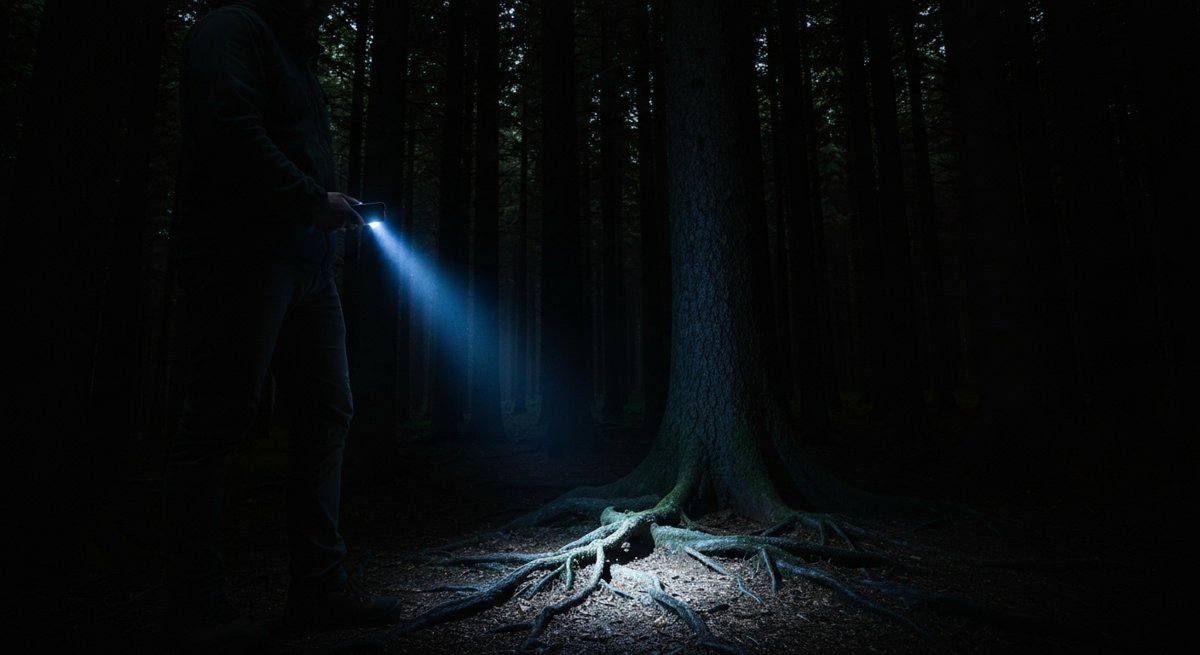
Here’s something that bugs me: people spend $1,200 on a phone, use it as their only flashlight, and then act surprised when they’re stumbling around in the dark with 8% battery at 11 PM.

Your phone flashlight is a parlor trick. It’s fine for finding the keyhole on your front door. But the moment you actually need light — a power outage, a flat tire on a rural highway, checking a weird noise outside at 2 AM — that little LED on the back of your phone is dangerously inadequate.

A dedicated flashlight is the single most underrated piece of everyday carry gear. Not a knife. Not a multitool. A light. And I’m going to tell you exactly why, what to look for, and how to pick one you’ll actually carry every day.

The Phone Flashlight Problem

Let’s get specific about why your phone light fails when it matters:

  • It eats your battery. Running that LED at full brightness drains your phone fast. In an emergency, your phone is your communication lifeline — burning battery on light is a terrible trade.
  • It’s a flood, not a throw. Phone lights blast a wide, weak wash of light. Try spotting a trail marker 50 feet away or reading a house number from your car. You can’t. The beam has zero reach.
  • It ties up your hands. You’re holding your $1,200 glass slab in one hand while trying to work with the other. Change a tire like that. Fix a breaker. Not happening.
  • It’s fragile. Drop your phone face-down on gravel while using it as a flashlight, and now you’ve got a cracked screen AND no light.
  • Zero output control. You get one brightness level. No low mode for reading without blinding yourself. No strobe for signaling. No red mode for preserving night vision.

I’m not saying your phone light is useless. It’s a backup to your backup. But carrying it as your primary light source is like using a butter knife as your only blade — technically it cuts, but you’re kidding yourself.

What a Real EDC Flashlight Gives You

A proper pocket flashlight — even a budget one — is a different universe:

  • 300-1000+ lumens on demand. That’s 10-30x brighter than your phone. You can light up an entire backyard or throw a beam 200+ meters down a road.
  • Multiple modes. A good EDC light gives you moonlight mode (1-5 lumens for reading in a tent without waking everyone), medium for walking, high for searching, and turbo for “what the hell was that” moments.
  • Dedicated battery. Your phone stays charged. Your light does its job. Two separate systems, zero conflict.
  • Pocket clip carry. Clips right next to your knife. You forget it’s there until you need it, and then it’s instantly in your hand.
  • Built tough. Aluminum body, impact-rated, usually waterproof to IPX8. Drop it, kick it, use it in the rain. It doesn’t care.

How to Pick an EDC Flashlight (Without Getting Lost in Flashlight Nerd Territory)

The flashlight world has a rabbit hole that rivals mechanical keyboards. People mod drivers, swap emitters, debate color temperatures like sommeliers argue about wine. You don’t need any of that. Here’s what actually matters for a daily carry light:

1. Size: It Has to Disappear in Your Pocket

If you won’t carry it, it’s worthless. The best EDC flashlights are roughly the size of your thumb — maybe 3-4 inches long. They run on a single AA, AAA, or rechargeable 14500/16340 battery. If it’s bigger than a Sharpie marker, it’s not EDC — it’s a bag light.

2. Lumens: 300-600 Is the Sweet Spot

Ignore the lumen wars. You don’t need 5,000 lumens in your pocket (and that much output generates heat that’ll step down in seconds anyway). For daily use, 300-600 lumens on high is plenty. What you really want is a good low mode — somewhere around 1-15 lumens — because that’s the mode you’ll use 80% of the time. Walking the dog, checking a fuse box, finding something under the seat.

3. Battery: Rechargeable or Common

Two schools of thought, both valid:

  • USB-C rechargeable — most convenient for daily use. Plug it in when you charge your phone. Lithium-ion gives you higher output.
  • AA/AAA compatible — you can find these batteries literally anywhere on earth. If grid-down is part of your planning, this matters. Some lights take both lithium-ion AND standard alkaline — best of both worlds.

My personal lean: USB-C rechargeable for your pocket light, AA-compatible for your get-home bag or truck kit.

4. UI: Simple Beats Clever

Some flashlights have user interfaces more complicated than a fighter jet. You don’t want to be clicking through 14 sub-modes at 2 AM. The ideal UI: click on (starts at last used mode or a sensible default), hold to cycle brightness, double-click for turbo. That’s it. If you need to read a manual to turn it on, pass.

5. Pocket Clip and Tail Stand

A reversible pocket clip lets you carry it bezel-up or bezel-down (personal preference — I like bezel-down so I can pull it and it’s already in a forward grip). Tail-standing means you can set it on its end and bounce light off a ceiling for area lighting. It’s a small feature that you’ll use constantly during power outages.

Solid Picks at Every Budget

I’m not going to name one flashlight and call it the best. Your budget and use case matter. But here are reliable tiers:

  • Under $30: Lumintop Tool AA 3.0, Wurkkos FC11. Both are rechargeable, well-built, and punch way above their price. This is the “no excuses” tier — anyone can afford this.
  • $30-60: Skilhunt M150 V3, Fenix E09R. Better build quality, nicer emitters (meaning the light looks more natural, less blue/green), smoother UIs.
  • $60-100: Zebralight SC64c LE, Malkoff MDC. This is “buy once, carry forever” territory. Bombproof construction, efficient drivers, regulated output. You’ll hand these down to your kids.

Honestly? Start at the under-$30 tier. Carry it for a month. You’ll be shocked how often you use it — and you’ll wonder how you ever got by without one.

Where Most People Go Wrong

Three mistakes I see constantly:

  1. Buying a tactical flashlight for EDC. Those 6-inch, 2,000-lumen weapon lights are awesome — mounted on a rifle. In your pocket, they’re a brick. Get something small enough to actually carry.
  2. Chasing max lumens. Runtime matters more than peak output for daily carry. A light that does 500 lumens for 2 hours beats one that does 2,000 lumens for 3 minutes before stepping down to 200.
  3. Keeping it in a bag instead of on-body. If it’s in your backpack, it’s not EDC — it’s “stuff in your bag.” True EDC means it’s on your person. Pocket clip, every day, no exceptions.

The Takeaway

A dedicated flashlight is the highest-impact, lowest-cost upgrade you can make to your everyday carry. For $25-30, you get a tool that outperforms your phone light by an order of magnitude, preserves your phone battery for communication, and works in conditions that would wreck your phone.

Here’s your challenge: This week, order a budget EDC flashlight — a Lumintop Tool AA or a Wurkkos FC11 — and commit to carrying it in your pocket for 30 days. Clip it right next to where your knife goes. By day 10, you’ll reach for it instinctively. By day 30, you’ll feel naked without it.

Stop using a $1,200 computer as a $2 flashlight. Carry a real light.

Stop Overpacking Your Truck: How to Build a Vehicle EDC Kit That Actually Gets Used

Here’s the pattern I see constantly: someone gets into preparedness, buys a massive tactical backpack, stuffs it with 40 pounds of gear, throws it behind the driver’s seat, and never touches it again. Six months later, the water’s expired, the batteries are dead, and they can’t find the one thing they actually need — a decent flashlight — because it’s buried under three MREs and a folding saw.

The problem isn’t the gear. It’s the approach. A vehicle EDC kit shouldn’t be a bug-out bag. It should be a curated, organized set of tools you actually reach for — on a regular Tuesday when you need to cut zip ties, charge a dead phone, or fix a flat in the dark.

Let me show you how to build one that works.

The Two-Tier System: Daily Reach vs. Emergency Backup

The key to a vehicle kit that actually gets used is splitting it into two layers:

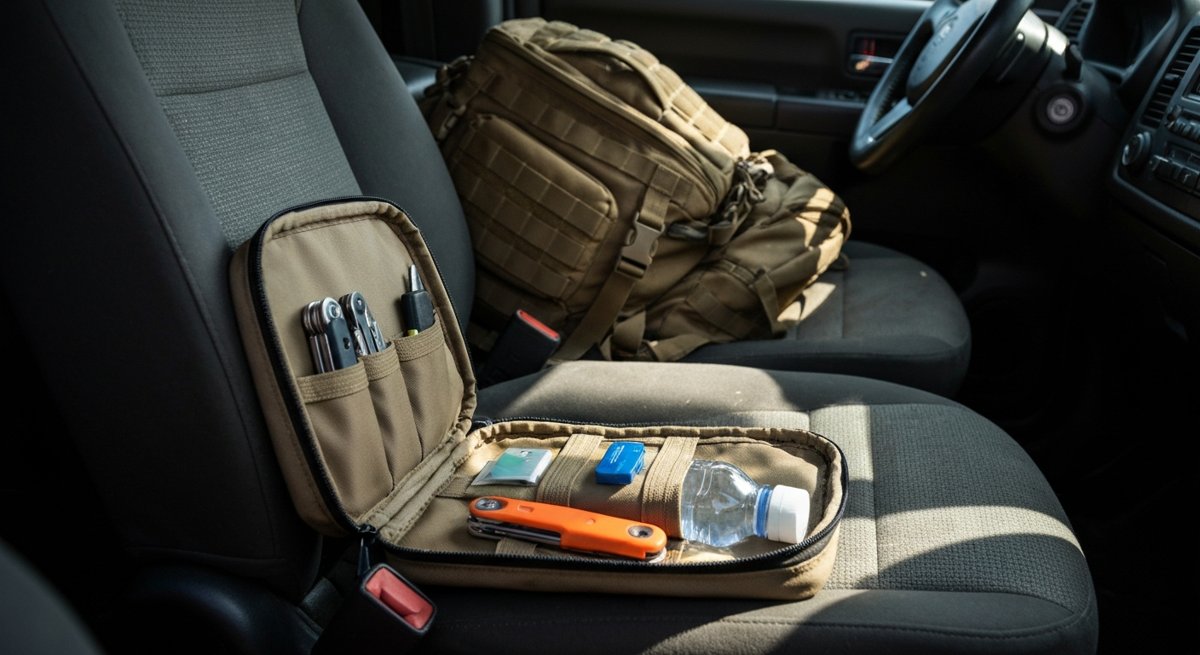
Tier 1 — The Daily Reach Pouch. This is small. Think organizer pouch or glove-box insert. These are the items you grab weekly or even daily. They live within arm’s reach — center console, door pocket, or glove box.

Tier 2 — The Trunk Kit. This is your emergency layer. It stays packed and organized in a rigid container in your trunk or truck bed. You touch it monthly to rotate water and check batteries, but when you need it, you know exactly where everything is.

This separation is everything. When your daily-use items are mixed in with emergency gear, you stop reaching for any of it.

Tier 1: Your Daily Reach Kit (6 Items Max)

Constraint is the point here. If it doesn’t fit in an organizer the size of a large paperback, you’re overpacking this tier. Here’s what earns a spot:

1. A quality folding knife. Not a $200 collector piece you’re afraid to use. A solid, mid-range folder with a 3–3.5 inch blade that you’ll actually pull out to cut cordage, open packages, or strip wire. I like the Civivi Elementum or Ontario RAT II for this role — under $50, great steel, zero guilt using them hard.

2. A compact flashlight (600+ lumens). Not the 3,000-lumen tactical cannon. A single-cell 18650 or even AA light that fits in your hand, throws enough light to check under the hood or illuminate a trail at night. The sweet spot is 600–1,000 lumens with a low moonlight mode. Charge it when you charge your phone — make it a habit.

3. A USB charging cable and small power bank. Boring? Sure. But when your phone dies at 4% and you need maps, this is worth more than your fixed-blade collection. A 10,000mAh bank is plenty — charges most phones twice. Keep it topped off.

4. A pen and waterproof notepad. You’ll use these more than you think. Jotting down license plates, notes, measurements, phone numbers when your hands are too dirty for a touchscreen. Fisher Space Pen is the gold standard, but any metal-body pen works.

5. A lighter. Even if you don’t smoke. A simple Bic lighter is the most reliable fire source ever made and costs a dollar. Toss one in the pouch and forget about it until you need it.

6. Cash. $40–60 in small bills. Folded flat in the pouch. When the card reader’s down, the power’s out, or you need to tip someone for a jump start, cash is king. Don’t overthink this — just put it in there.

Tier 2: The Trunk Emergency Kit

This lives in a rigid container — a small plastic tote or ammo can, not a soft bag. Why? Because in your trunk, soft bags get crushed, shift around, and lose their shape. A rigid box stays organized and stackable.

Here’s what goes in it:

  • Jumper cables or a lithium jump starter. The jump starter is better — it’s compact, works solo, and most double as a power bank. Worth the $60–80.
  • Basic first aid kit. Not a field surgery kit. Band-aids, gauze, medical tape, ibuprofen, antihistamines, and a tourniquet if you’ve trained with one. If you haven’t trained with a tourniquet, skip it — gear you can’t use is dead weight.
  • Two bottles of water. Rotate quarterly. Mark the date on the cap with a Sharpie.
  • A rain poncho. One of those $3 emergency ponchos, still in the wrapper. Takes up zero space and turns a miserable roadside tire change into a merely annoying one.
  • Work gloves. Mechanix or similar. Changing a tire, moving debris, handling broken glass — bare hands are a liability.
  • A multi-tool. This is where your Leatherman or Gerber lives. Pliers, screwdrivers, a blade — the multi-tool is for problems that need more than a folding knife.
  • Duct tape. Wrap 10 feet around an old gift card. Takes up almost no space, fixes almost anything temporarily.
  • Reflective triangle or road flares. If you’re stopped on the shoulder at night, visibility is survival. Non-negotiable.
  • A basic tow strap. 20-foot, 10,000lb rated. Not a bungee cord. Not a ratchet strap. An actual recovery strap. If you live anywhere with mud, snow, or ditches, this will save you a tow truck bill at least once.

The Part Everyone Skips: Maintenance

A kit you build and forget is a kit that fails when you need it. Set a quarterly reminder — first day of each season works great. Takes five minutes:

  1. Check water expiration. Replace if needed.
  2. Test the flashlight and jump starter. Charge both.
  3. Verify the power bank has charge.
  4. Check the first aid kit — anything used? Replace it.
  5. Cash still there? (Seriously. It walks.)

That’s it. Five checks, five minutes, four times a year.

What NOT to Put in Your Vehicle Kit

This is where I’ll get some pushback, but here’s my honest take on what doesn’t belong:

  • MREs or heavy food. They take up too much space, they’re affected by heat, and unless you’re driving through the Nevada desert for 12 hours, you don’t need them. A couple of granola bars in Tier 2 is fine. Anything more is cosplay.
  • Weapons beyond your folding knife. Your vehicle kit is for roadside problems and minor emergencies. If personal defense is a priority, that’s a separate, dedicated decision — not something to lump in with your jumper cables.
  • Survival blankets as your only warmth layer. Those crinkly mylar blankets are better than nothing, but only barely. If you live somewhere cold, keep an actual fleece blanket or jacket in the trunk. It doubles as a picnic blanket the other 11 months.
  • Anything you haven’t tested. That fire starter kit you bought? Have you used it? The water filter straw? Ever actually drunk through one? Don’t carry gear you can’t operate under stress. Period.

The Takeaway

The best vehicle EDC kit isn’t the biggest one. It’s the one you actually use, actually maintain, and can actually find things in when it’s dark, raining, and your hands are shaking.

Build it in two tiers. Keep the daily stuff within reach. Keep the emergency stuff organized in a rigid box. Review it quarterly. Done.

Your challenge this week: Pull everything out of your vehicle right now — glove box, center console, trunk, under the seats. Lay it all out. How much of it is actually useful? How much is junk drawer overflow? Rebuild it with intent. Two tiers. Six items max for Tier 1. One rigid box for Tier 2. Report back.