

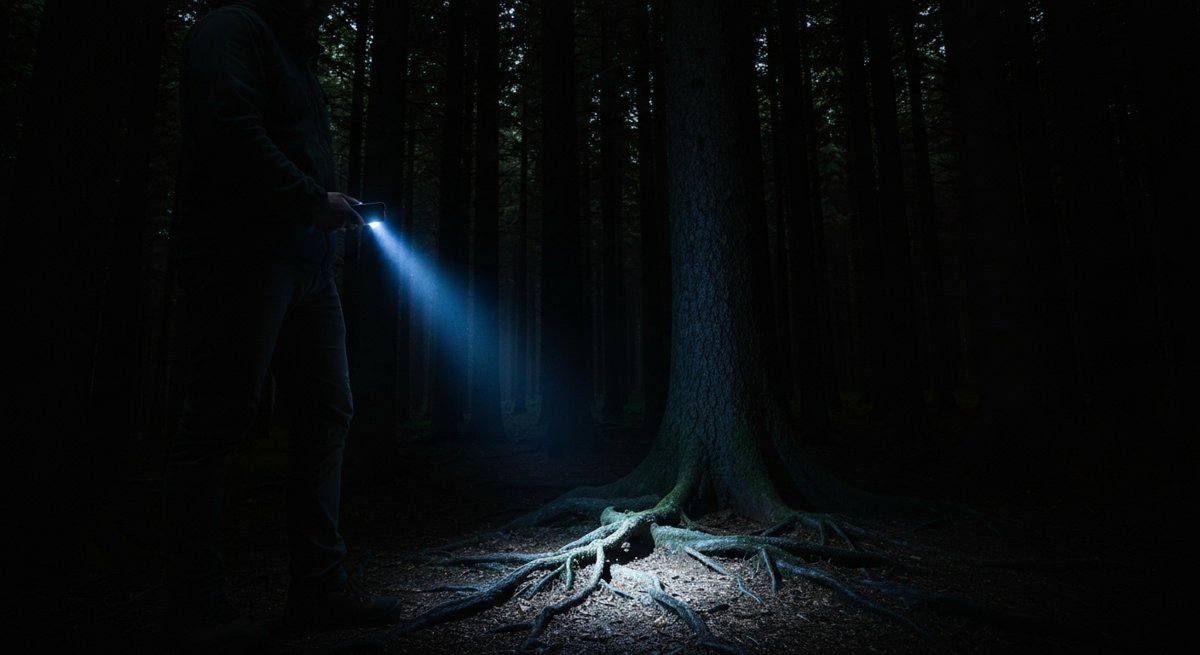
Here’s something that bugs me: people spend $1,200 on a phone, use it as their only flashlight, and then act surprised when they’re stumbling around in the dark with 8% battery at 11 PM.
Your phone flashlight is a parlor trick. It’s fine for finding the keyhole on your front door. But the moment you actually need light — a power outage, a flat tire on a rural highway, checking a weird noise outside at 2 AM — that little LED on the back of your phone is dangerously inadequate.
A dedicated flashlight is the single most underrated piece of everyday carry gear. Not a knife. Not a multitool. A light. And I’m going to tell you exactly why, what to look for, and how to pick one you’ll actually carry every day.
The Phone Flashlight Problem
Let’s get specific about why your phone light fails when it matters:
- It eats your battery. Running that LED at full brightness drains your phone fast. In an emergency, your phone is your communication lifeline — burning battery on light is a terrible trade.
- It’s a flood, not a throw. Phone lights blast a wide, weak wash of light. Try spotting a trail marker 50 feet away or reading a house number from your car. You can’t. The beam has zero reach.
- It ties up your hands. You’re holding your $1,200 glass slab in one hand while trying to work with the other. Change a tire like that. Fix a breaker. Not happening.
- It’s fragile. Drop your phone face-down on gravel while using it as a flashlight, and now you’ve got a cracked screen AND no light.
- Zero output control. You get one brightness level. No low mode for reading without blinding yourself. No strobe for signaling. No red mode for preserving night vision.
I’m not saying your phone light is useless. It’s a backup to your backup. But carrying it as your primary light source is like using a butter knife as your only blade — technically it cuts, but you’re kidding yourself.
What a Real EDC Flashlight Gives You
A proper pocket flashlight — even a budget one — is a different universe:
- 300-1000+ lumens on demand. That’s 10-30x brighter than your phone. You can light up an entire backyard or throw a beam 200+ meters down a road.
- Multiple modes. A good EDC light gives you moonlight mode (1-5 lumens for reading in a tent without waking everyone), medium for walking, high for searching, and turbo for “what the hell was that” moments.
- Dedicated battery. Your phone stays charged. Your light does its job. Two separate systems, zero conflict.
- Pocket clip carry. Clips right next to your knife. You forget it’s there until you need it, and then it’s instantly in your hand.
- Built tough. Aluminum body, impact-rated, usually waterproof to IPX8. Drop it, kick it, use it in the rain. It doesn’t care.
How to Pick an EDC Flashlight (Without Getting Lost in Flashlight Nerd Territory)
The flashlight world has a rabbit hole that rivals mechanical keyboards. People mod drivers, swap emitters, debate color temperatures like sommeliers argue about wine. You don’t need any of that. Here’s what actually matters for a daily carry light:
1. Size: It Has to Disappear in Your Pocket
If you won’t carry it, it’s worthless. The best EDC flashlights are roughly the size of your thumb — maybe 3-4 inches long. They run on a single AA, AAA, or rechargeable 14500/16340 battery. If it’s bigger than a Sharpie marker, it’s not EDC — it’s a bag light.
2. Lumens: 300-600 Is the Sweet Spot
Ignore the lumen wars. You don’t need 5,000 lumens in your pocket (and that much output generates heat that’ll step down in seconds anyway). For daily use, 300-600 lumens on high is plenty. What you really want is a good low mode — somewhere around 1-15 lumens — because that’s the mode you’ll use 80% of the time. Walking the dog, checking a fuse box, finding something under the seat.
3. Battery: Rechargeable or Common
Two schools of thought, both valid:
- USB-C rechargeable — most convenient for daily use. Plug it in when you charge your phone. Lithium-ion gives you higher output.
- AA/AAA compatible — you can find these batteries literally anywhere on earth. If grid-down is part of your planning, this matters. Some lights take both lithium-ion AND standard alkaline — best of both worlds.
My personal lean: USB-C rechargeable for your pocket light, AA-compatible for your get-home bag or truck kit.
4. UI: Simple Beats Clever
Some flashlights have user interfaces more complicated than a fighter jet. You don’t want to be clicking through 14 sub-modes at 2 AM. The ideal UI: click on (starts at last used mode or a sensible default), hold to cycle brightness, double-click for turbo. That’s it. If you need to read a manual to turn it on, pass.
5. Pocket Clip and Tail Stand
A reversible pocket clip lets you carry it bezel-up or bezel-down (personal preference — I like bezel-down so I can pull it and it’s already in a forward grip). Tail-standing means you can set it on its end and bounce light off a ceiling for area lighting. It’s a small feature that you’ll use constantly during power outages.
Solid Picks at Every Budget
I’m not going to name one flashlight and call it the best. Your budget and use case matter. But here are reliable tiers:
- Under $30: Lumintop Tool AA 3.0, Wurkkos FC11. Both are rechargeable, well-built, and punch way above their price. This is the “no excuses” tier — anyone can afford this.
- $30-60: Skilhunt M150 V3, Fenix E09R. Better build quality, nicer emitters (meaning the light looks more natural, less blue/green), smoother UIs.
- $60-100: Zebralight SC64c LE, Malkoff MDC. This is “buy once, carry forever” territory. Bombproof construction, efficient drivers, regulated output. You’ll hand these down to your kids.
Honestly? Start at the under-$30 tier. Carry it for a month. You’ll be shocked how often you use it — and you’ll wonder how you ever got by without one.
Where Most People Go Wrong
Three mistakes I see constantly:
- Buying a tactical flashlight for EDC. Those 6-inch, 2,000-lumen weapon lights are awesome — mounted on a rifle. In your pocket, they’re a brick. Get something small enough to actually carry.
- Chasing max lumens. Runtime matters more than peak output for daily carry. A light that does 500 lumens for 2 hours beats one that does 2,000 lumens for 3 minutes before stepping down to 200.
- Keeping it in a bag instead of on-body. If it’s in your backpack, it’s not EDC — it’s “stuff in your bag.” True EDC means it’s on your person. Pocket clip, every day, no exceptions.
The Takeaway
A dedicated flashlight is the highest-impact, lowest-cost upgrade you can make to your everyday carry. For $25-30, you get a tool that outperforms your phone light by an order of magnitude, preserves your phone battery for communication, and works in conditions that would wreck your phone.
Here’s your challenge: This week, order a budget EDC flashlight — a Lumintop Tool AA or a Wurkkos FC11 — and commit to carrying it in your pocket for 30 days. Clip it right next to where your knife goes. By day 10, you’ll reach for it instinctively. By day 30, you’ll feel naked without it.
Stop using a $1,200 computer as a $2 flashlight. Carry a real light.