

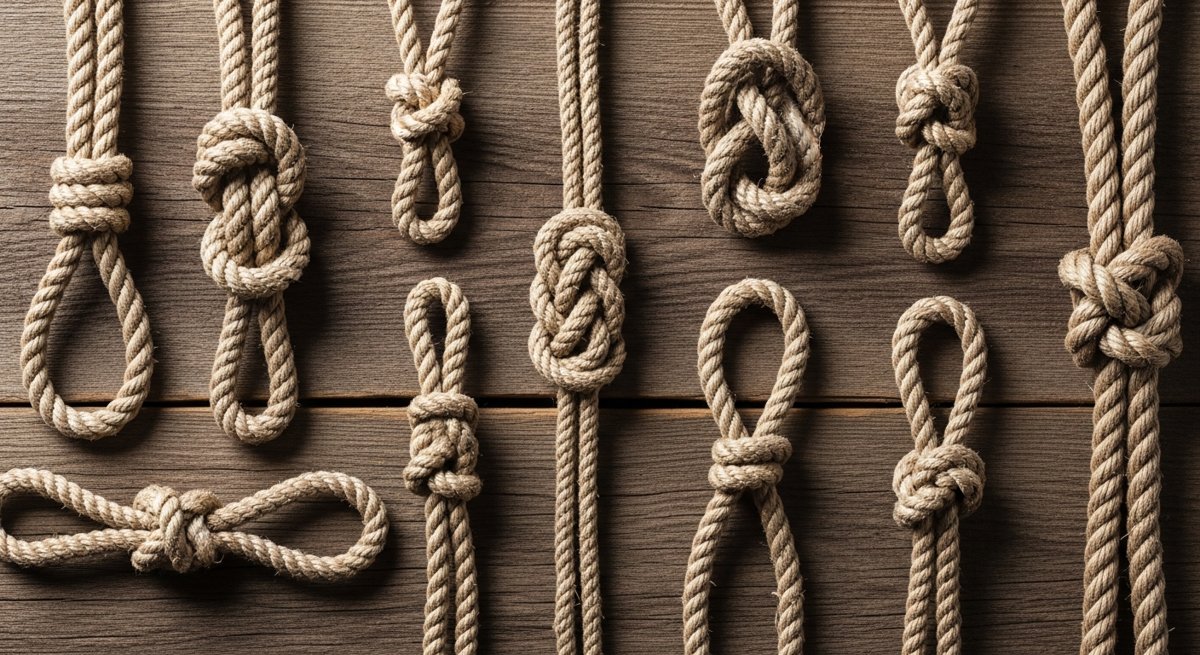
There are roughly 4,000 knots in the world. You need ten. Maybe twelve if you’re feeling fancy. The rest are variations, edge cases, or someone showing off at a sailing convention.
Here’s the truth: most adults can’t tie a single knot beyond the one in their shoes — and even that one is usually wrong (more on that later). That’s a problem. Knots aren’t a hobby. They’re a quiet, useful skill that pays you back the first time you need to tow a stuck truck, secure a load that won’t shift, or rig a tarp in the rain when the wind decides to be a jerk.
I’m going to give you ten knots. Each one with a clear purpose, when to grab it, and when to walk past it. Learn them in order. Practice each one until you can tie it in the dark, in the cold, with one hand pinned. Because that’s when you’ll actually need it.
Before You Tie Anything: Three Rules
- Dress your knots. A knot pulled tight without first arranging the strands neatly is half its strength. Pull it snug, look at it, then load it.
- Leave a tail. At least four times the rope’s diameter. A short tail is how knots come undone at the worst possible moment.
- The right knot beats the strong knot. A bowline tied wrong is worse than a square knot tied right. Match the knot to the job.
1. The Bowline — The King of Knots
When to use it: Anytime you need a fixed loop at the end of a rope that won’t slip, won’t tighten under load, and unties easily after.
If you only learn one knot from this list, learn the bowline. Mountaineers use it. Sailors use it. Rescue workers use it. It’s the knot you tie around your waist if someone’s pulling you out of a hole.
The classic memory trick: the rabbit comes out of the hole, around the tree, and back down the hole. Sounds dumb, works perfectly. Practice it 50 times. Then practice it 50 more times with your eyes closed.
2. The Figure 8 (and Figure 8 on a Bight)
When to use it: A stopper at the end of a line, or a fixed loop you trust your life to.
Climbers use the figure 8 follow-through to tie into their harness because it’s nearly impossible to tie wrong in a way that fails — you can see the mistake. The figure 8 on a bight (tied in a loop in the middle of the rope) is the go-to for anchor points and clipping in.
This is the "I’d rather be alive than fancy" knot. Use it.
3. The Two Half Hitches
When to use it: Tying a rope to a post, ring, tree, or bumper. Quickly. Reliably. With minimal thinking.
Two half hitches is the workhorse of tying-things-to-other-things. It cinches down on the object, holds under steady load, and is fast. Add a third hitch for slippery rope or critical loads.
This is the knot you use when you’re tarping a load in the truck bed and it’s about to rain.
4. The Taut-Line Hitch
When to use it: Tarp ridgelines, tent guy lines, anything you need to adjust after tying.
The genius of this knot: it slides freely when you push it with your hand, but grips like a vise under load. Set up a tarp, tie taut-line hitches at the corners, and you can tighten the whole rig by sliding the hitches up the line.
If you camp, hike, or rig shelters, this knot replaces the dumb plastic tensioners that come with cheap tents.
5. The Trucker’s Hitch
When to use it: Cinching down a load on a truck, trailer, roof rack, or canoe. Anywhere you need real mechanical advantage with rope.
This is the closest thing to a ratchet strap you can build with rope alone. It gives you roughly 3:1 mechanical advantage. Tie it once and you’ll never again wonder if your kayak is about to pull a yard sale on the highway.
6. The Clove Hitch
When to use it: Quick attachment to a post or pole when the load is steady and pulling perpendicular.
Fast to tie, fast to untie, perfect for temporary tasks like lashing a pole or hanging a lantern. Don’t trust it as your only knot for critical loads — it can roll loose when the load shifts. But for a hundred small jobs, it’s perfect.
7. The Square Knot (Reef Knot)
When to use it: Joining two ropes of the same diameter, under light, steady load. Bandages. Stuff sacks. Bundling firewood.
And here’s the truth most people don’t want to hear: the square knot is dangerous when used to join ropes for anything that matters. It can capsize and slip under uneven load. It’s a binding knot, not a bend. Use it for tying a bundle, not for tying your safety line.
Bonus: your shoelaces are square knots. If yours come untied constantly, you’re tying a granny knot — the slipped, weaker version. Reverse the direction of your second loop and you’ll never tie your shoes wrong again.
8. The Sheet Bend
When to use it: Joining two ropes of different diameters, or a rope to a loop.
This is what you should reach for instead of a square knot when you need to join two ropes. It works with mismatched ropes, holds under load, and unties cleanly. Double it (the double sheet bend) for slippery synthetic rope.
9. The Prusik Hitch
When to use it: Climbing a fixed rope. Backing up a rappel. Hauling. Self-rescue.
The prusik is a friction hitch tied with a small loop of cord around a larger rope. Slide it freely, weight it, it locks. This is how rescuers and climbers ascend ropes. It’s also how you build a 3:1 haul system to drag a stuck truck or a fallen tree.
You probably won’t use it weekly. You’ll be glad you know it the day you need it.
10. The Constrictor Knot
When to use it: Permanently binding something tight. Hose clamps. Sausage ties. Closing the end of a rope to keep it from fraying. Temporary "weld" on a torn item.
The constrictor is the world’s most aggressive binding knot. Once you cinch it down, it’s basically there forever — you’ll cut it off rather than untie it. That’s the point. When you need something to stay bound, this is the knot.
The Bonus Two (If You’re Hungry for More)
- The Alpine Butterfly: A loop in the middle of a rope, tied without access to either end. Perfect for isolating a damaged section of rope or building an anchor point mid-line.
- The Bowline on a Bight: A double-loop bowline tied in the middle of a rope. Useful for improvised harnesses and equalized anchors.
How to Actually Learn These
Here’s what I’ve learned from teaching knots to grown adults: watching a YouTube video doesn’t count as learning. Your hands need to do it. Cold, wet, half-asleep, with the rope slipping — that’s the only way the knowledge gets locked in.
- Buy 10 feet of cheap 1/4" nylon utility rope. Cut it into two 5-foot pieces. Keep them on your desk.
- Pick one knot per week. Tie it 20 times in the morning. 20 times before bed.
- By the end of week 10, you’ll know all of these in your fingers, not just your head.
Why This Matters
You don’t need to be a survivalist to need knots. You need to tow a friend’s car. Lash a Christmas tree to your roof. Set up a hammock on a trip. Bind a torn pack strap until you can fix it. Build a clothesline. Tie down a tarp before a storm. Hang a deer to age. Build a gate that closes properly. Rescue a dog out of a creek.
The world is held together by string. The people who know how to tie it are the people who fix problems instead of waiting for someone else to.
Your Challenge
Get a length of rope by the end of this week. By Sunday night, learn one knot from this list cold — tied 20 times, eyes closed by the last 5. Start with the bowline. Send the next person who asks "can you tie this?" into mild shock.
Then tie the next knot next week. By July, you’ll be the one people call when something needs tying. That’s a useful kind of person to be.