

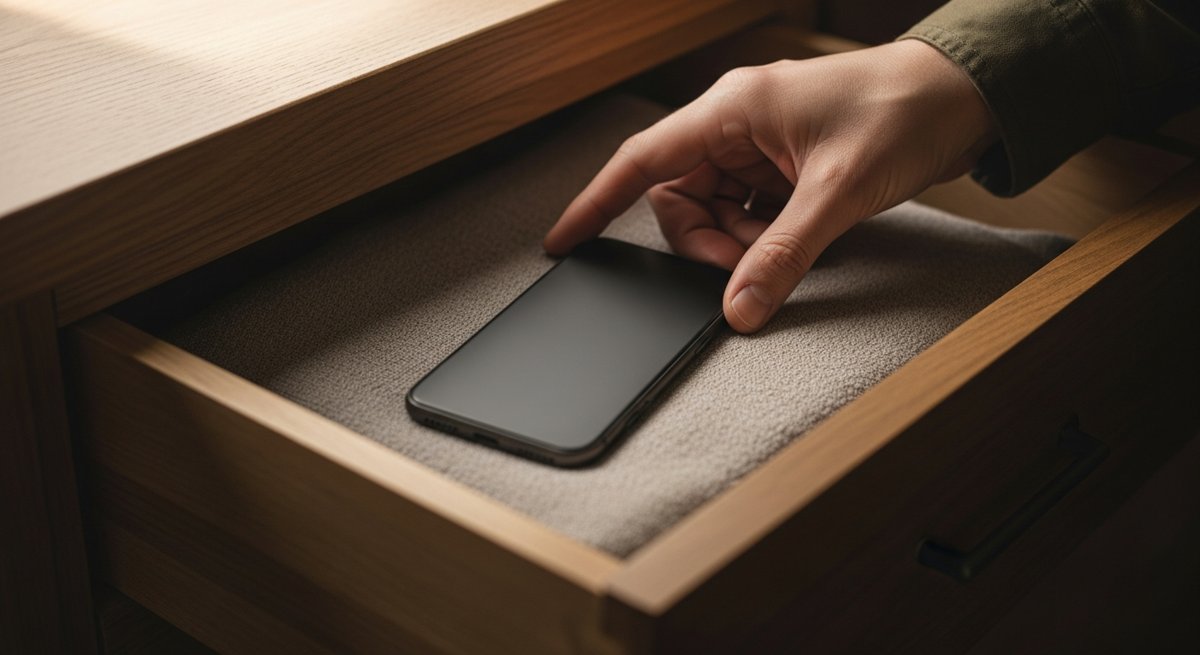
I put my phone in a drawer for seven days. Not airplane mode. Not “do not disturb.” In a drawer, across the house, on a shelf I had to drag a stool over to reach. Here’s what actually happened — and the exact playbook so you can do it without quitting your job or going off the grid.
Let’s get one thing straight up front: this isn’t a guilt trip about screen time. You already know you’re on your phone too much. The average American touches their phone 2,600 times a day and burns somewhere north of four hours on it. You don’t need another article waving that stat at you like a wagging finger. What you need is a way to actually do something about it that doesn’t blow up your real life. So that’s what this is.
Why a Full Week, Not “Just Cut Back”
“Cutting back” is the diet version of phone use — it sounds reasonable and it fails for the same reason crash diets fail: there’s no clear line, so every moment becomes a negotiation. “Just one quick check” is a battle you fight 200 times a day, and you lose most of them by lunch.
A hard boundary kills the negotiation. The phone is in the drawer. There’s nothing to decide. Your brain stops asking. And here’s the part nobody tells you — the craving curve is shorter than you think. The first two days are genuinely rough. By day four, the itch is mostly gone. By day seven you’ll catch yourself slightly annoyed that you have to pick the thing back up. That arc is the whole point. You can’t feel it if you only “cut back,” because you never let the withdrawal finish.
The Honest Setup (Do This the Night Before)
A detox that requires you to be a monk fails by Tuesday. The trick is to keep the two or three things your phone genuinely does for you, and amputate the other forty. Here’s the night-before checklist:
- Buy a real alarm clock. This is the single most important purchase of the whole experiment. The phone-as-alarm is the Trojan horse — it’s the reason the phone is the first and last thing you touch every day. A $15 analog clock on the nightstand means the phone never needs to enter the bedroom. Do not skip this one.
- Tell three people. Text your partner, your boss, and whoever’s most likely to panic if you go quiet: “Off my phone for a week. Call the landline / email me / here’s how to reach me in an emergency.” Two minutes of setup buys you a week of guilt-free silence.
- Move the two “load-bearing” apps to your laptop. Banking, maps, whatever you genuinely need. You’re detoxing from the casino in your pocket, not from modern life. Doing your banking at a desk once a day is fine. Doing it in line at the grocery store 14 times is the problem.
- Pick the drawer. Physical distance matters more than willpower. Across-the-house beats across-the-room beats face-down-on-the-desk. Make retrieval annoying on purpose.
The Day-by-Day Reality
Days 1–2: The phantom buzz. You’ll reach for a phone that isn’t there. Your hand will literally pat your pocket. You’ll feel a buzz that didn’t happen. This is real — it’s called phantom vibration syndrome and it’s your nervous system running a search for a hit it’s not getting. Annoying, harmless, gone in 48 hours. The hardest moments are the “dead time” gaps: waiting for coffee, the elevator, the bathroom (yeah, that one). Have a plan for the gaps or they’ll break you.
Days 3–4: The fog lifts. This is where it gets interesting. The compulsive reach starts to fade and something weird shows up in its place: you get bored, and then you get creative with the boredom. I reorganized a closet I’d been ignoring for a year. I called my brother for no reason. The mental real estate that scrolling was renting out goes back on the market.
Days 5–7: The recalibration. By here, your baseline has reset. You sleep harder. You finish thoughts. Conversations feel longer in a good way because you’re not half-checked-out waiting for a notification. The most telling sign: you stop missing it. That’s the proof the dependency was a habit loop, not a need.
Fill the Void or It Fills Itself
Here’s the mistake that sinks most attempts: people remove the phone and leave a vacuum. A vacuum gets filled by whatever’s nearest — the TV, the fridge, doomscrolling on a laptop instead. You have to pre-load the replacement. The cleanest swap I know is a physical book parked exactly where your phone used to live: on the nightstand, on the kitchen counter, in your bag.
If you want the detox to stick past day seven, read something about habits themselves while you’re in the clear-headed window — it lands harder when you’re actually living it. Atomic Habits by James Clear is the obvious pick — its whole engine is “make the bad habit invisible, make the good one obvious,” which is literally what putting the phone in a drawer does. If you want something with more grit and less framework, Can’t Hurt Me by David Goggins is the kick in the pants version. Either one beats a feed.
Other void-fillers that earned their spot during my week: a notebook for the random thoughts that used to become Google searches, a deck of cards, and a standing “go for a walk with no destination” rule for the witching hour around 8 p.m. when the pull is strongest.
What I Actually Learned (The Part That Surprised Me)
I expected to feel more relaxed. I did. What I didn’t expect was how much of my phone use had nothing to do with wanting anything — it was pure fidget. Ninety percent of the reaches were my hand looking for a job, not my brain looking for information. Once I clocked that, the phone got smaller. It went from “the device my life runs on” to “a useful tool I pick up on purpose.” That reframe is the real prize, and it outlasts the week.
The other surprise: nothing broke. No crisis happened because I was 30 minutes slower to reply. The world’s demand for your instant attention is almost entirely manufactured — by the apps, and by the version of you that trained everyone to expect an immediate response. Both of those can be retrained.
Don’t Want a Full Week? Do the 80% Version.
If seven phone-free days is a non-starter for your job or your kids, here’s the version that still delivers most of the benefit:
- Phone sleeps in another room. Every night. Non-negotiable. This one rule fixes mornings and evenings, the two times that set the tone for everything else.
- No phone for the first hour and last hour of the day. Bookend your day with your own thoughts instead of someone else’s algorithm.
- One full day a week — pick Sunday. A weekly “screen sabbath” gives you the reset on repeat without the upfront pain of a whole week.
Do those three and you’ve captured the lion’s share of what the full detox teaches, on permanent repeat.
The Challenge
Tonight, before you go to bed, do exactly one thing: charge your phone in a different room. Not tomorrow, not “when things calm down” — tonight. Buy the cheap alarm clock this week so it sticks. That single move is the keystone the entire detox is built on, and it costs you nothing but a little discomfort.
Then, if you’re feeling bold, block out a Sunday and go the full distance. Worst case, you waste a week being a little bored and a lot more present. Best case, you get your attention back — and that’s the one thing nobody can sell back to you once it’s gone.
Put it in the drawer. Set the clock. See what’s on the other side of the boredom. I’ll bet it’s better than your feed.