

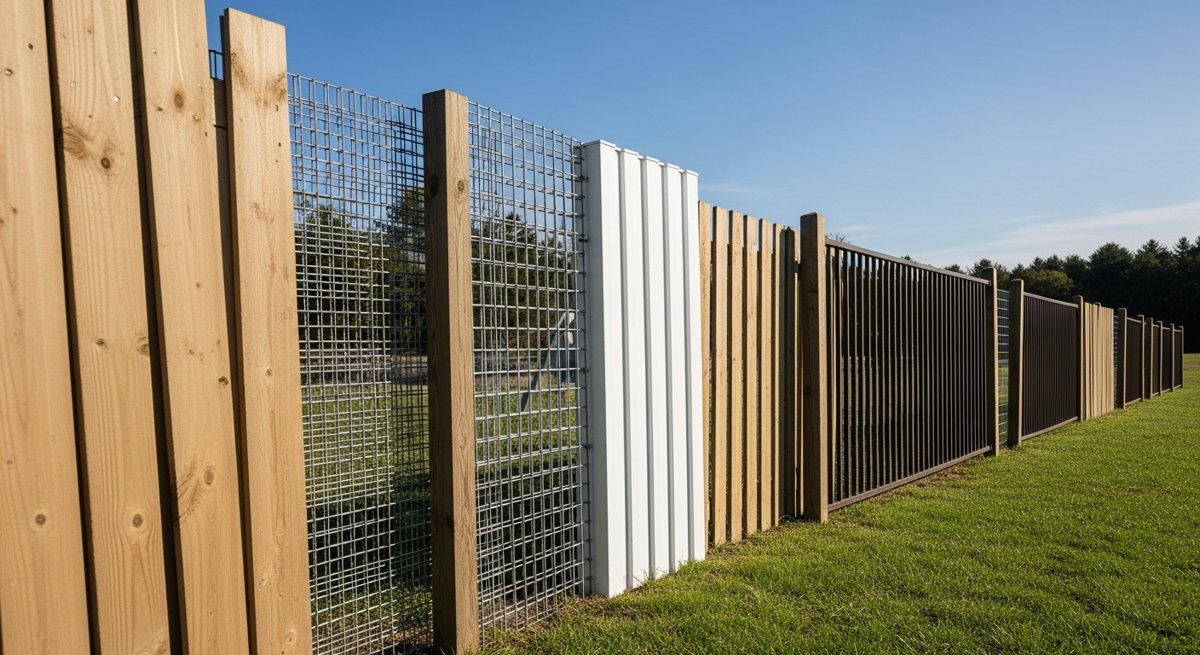
Ask three people what fencing costs and you’ll get the same useless answer: “it depends.” Sure it does. But you’re not trying to write a textbook — you’re trying to figure out if you can afford to fence the back five acres this fall. So let’s put real numbers on it.
Below is every common fencing material, ranked roughly cheapest to priciest, with honest 2026 per-foot ranges. These are materials-only, DIY numbers unless I say otherwise — because the second you hire a crew, you’re adding $3–$10 a foot in labor and the comparison falls apart. Steel and lumber prices bounce around by region, so treat these as the ballpark you budget against, not a quote.
How to actually read a fencing quote
Everything gets priced in linear feet, not square feet. One acre is roughly 209 feet on a side, so a square acre is about 835 feet of perimeter. Five acres in one square block? Around 1,870 feet. That math matters more than the per-foot price, because a 50-cent difference per foot is nothing on a garden bed and $900 on a pasture.
Three questions decide your material before cost even enters the picture: What are you keeping in or out? How long does it need to last? Are you doing the labor yourself? Answer those honestly and half these options eliminate themselves.
The cost breakdown, cheapest to priciest
1. Barbed wire — $0.75 to $2.00/ft
The default for cattle and big perimeters because nothing beats it on price. Five strands on T-posts with wood corner braces runs about a buck a foot in materials. It’s fast, it’s forgiving, and it’ll outlive your truck. Downsides: useless for anything smaller than a cow (goats and dogs walk right through), and it tears up anything that pushes on it — including you. Not a “looks nice from the road” fence.
2. High-tensile / electric — $0.50 to $1.50/ft
The smart-money choice for rotational grazing and long runs. The wire itself is cheap; your real cost is the energizer ($150–$400) and good grounding. Once it’s up, it’s the lowest-maintenance fence there is and a single charger can power miles. The catch is the learning curve — bad grounding means a dead fence and escaped animals, and that’s the #1 mistake people make. Get the grounding right and it’s the best dollar-per-foot value on this list.
3. Field / woven wire — $2.00 to $4.00/ft
The “no-climb” workhorse. A woven grid that actually contains goats, sheep, and dogs, which barbed wire never will. Add a strand of barbed or electric along the top and you’ve got a fence that holds almost anything. Stretching it properly is the whole game — a sloppy woven-wire job sags and looks terrible within a year. Worth the extra effort over barbed if you’ve got mixed livestock.
4. Welded wire & livestock panels — $2.00 to $4.00/ft
This is my favorite for garden enclosures, chicken runs, and small paddocks. A 16-foot cattle panel runs $30–$45 — call it $2–$3 a foot — and it’s rigid, so you don’t fight with stretching. Two people can build a serious garden fence or a hog pen in an afternoon. They also bend into arched trellises and quick hoop shelters, which is a homestead cheat code. The downside is hauling sixteen-foot panels, but most farm stores will cut them or you bend them onto a trailer.
5. Chain link — $4.00 to $12.00/ft
Boring, but it works. Great for dog yards and security perimeters, terrible for livestock and aesthetics. DIY materials sit in the middle of the pack; hire it out and you’re closer to $15–$25 installed. If you want a fence you’ll never think about again and don’t care how it looks, chain link earns its keep.
6. Pipe & continuous metal panel — $5.00 to $12.00/ft
The fence that lasts 50 years and looks like money. Standard around horse properties because nothing else takes a 1,200-pound animal leaning on it without flinching. Continuous panels bolt up fast; welded pipe is the gold standard but means you’re either hiring a welder or owning one. More on that in a second, because this is where a lot of homesteaders leave real money on the table.
7. Wood — $3.00 to $9.00/ft DIY (3–4x that installed)
Split rail is the cheap end and reads “ranch entrance.” Full board fence is the expensive end and reads “horse farm.” Wood is the looks champion, but it’s also the maintenance champion in the worst way — staining, replacing rotted boards, re-nailing after every freeze-thaw cycle. Beautiful for a front pasture or a short, visible run. Don’t wrap 2,000 feet in it unless you enjoy weekend carpentry forever.
8. Vinyl / PVC — $10.00 to $30.00/ft installed
The priciest mainstream option and the one I’d think hardest about. The pitch is “zero maintenance and looks like white board fence forever.” Mostly true. But the upfront cost is brutal at scale, cheap vinyl gets brittle and yellows, and a tractor bump that would dent steel will shatter a rail. Buy good vinyl or don’t bother. Best for a short, high-visibility frontage where you genuinely never want to touch it again.
Quick reference
| Material | DIY $/ft | Best for |
|---|---|---|
| Barbed wire | $0.75–$2.00 | Cattle, big perimeters |
| High-tensile electric | $0.50–$1.50 | Rotational grazing |
| Field / woven wire | $2.00–$4.00 | Goats, sheep, dogs |
| Welded wire / panels | $2.00–$4.00 | Gardens, runs, small pens |
| Chain link | $4.00–$12.00 | Dog yards, security |
| Pipe / metal panel | $5.00–$12.00 | Horses, lifetime fence |
| Wood | $3.00–$9.00 | Looks, short runs |
| Vinyl / PVC | $10.00–$30.00 | Zero-maintenance frontage |
The tools that actually save you money
Whatever material you pick, three hand tools turn a miserable weekend into a manageable one: a manual T-post driver (the heavy steel sleeve you slam down over the post — your back will thank you over a sledge), a pair of fencing pliers (hammer, wire cutter, staple puller, and grip in one tool), and a wire stretcher / come-along for pulling barbed and woven wire tight without it sagging in six months. Buy these once, cry once. Borrowed or rented, they’re the difference between a fence that looks intentional and one that looks like it gave up.
Where the real savings hide: build your own gates and brackets
Here’s the thing nobody puts in a cost comparison. A pre-made heavy-duty farm gate runs $200–$600. Brackets, braces, and corner hardware add up fast on top of your per-foot numbers. If you can run a basic bead, you can build gates, weld continuous pipe panels, and fabricate your own brackets for a fraction of retail — and a welded pipe corner brace will outlast every store-bought one on your property.
A hobby-grade MIG machine is the single highest-leverage tool on a homestead, and it pays for itself on the first big fencing job. The Eastwood MIG 180 welder is the classic do-it-all starter — enough power for gate frames, pipe fence, and the hundred other repairs that show up the moment animals do. If you want to compare amperage and budget, browse Eastwood’s MIG welder lineup and size it to your heaviest expected job, not your lightest. Learn it on scrap, then go build a gate that’ll outlive you.
What I’d actually do
If it were my land? High-tensile electric for the big perimeter, welded-wire panels for the garden and animal pens, and a few welded pipe gates at the access points. That combo covers 90% of homestead needs for the least money over the life of the fence, and it leans on DIY tools instead of a hired crew. I’d only spend on wood or vinyl where the road sees it. Everywhere else, function wins.
The most expensive fence is the one you build twice. Pick the material for the job, not the photo, set your corners and braces like your fence depends on them — because it does — and stretch everything tight the first time.
Your challenge this week
Walk your property line with a measuring wheel and write down your actual perimeter footage. Then multiply it by the two or three materials you’re realistically choosing between. You’ll be shocked how often the “expensive” option is only a few hundred dollars more than the cheap one once you’ve got real feet on paper — and how often the cheap one wasn’t actually cheaper after you priced the corners. Numbers first. Then dig the first hole.