

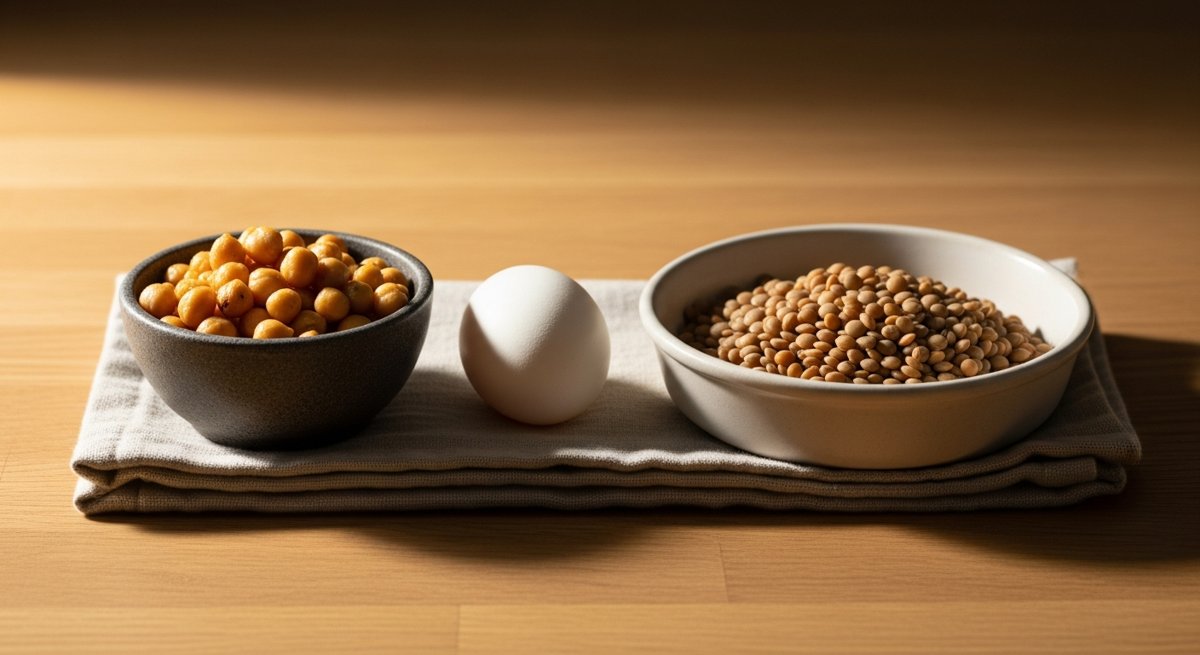
Walk down any supplement aisle and you’d think protein is some rare, precious resource you have to chase with powders, bars, and “anabolic windows.” The industry has a vested interest in keeping you anxious about it. So let’s clear the smoke: most people need less protein than the internet screams about — but plenty of people still aren’t hitting that lower number either. Both things are true.
This is the no-BS breakdown of how much protein you actually need, where to get it, and which “rules” you can throw in the trash.
The Number, Stripped of Marketing
There are two numbers that matter, and they’re miles apart.
The survival minimum (RDA): 0.36 grams per pound of bodyweight. That’s the amount that keeps a sedentary adult from developing a deficiency. It is not the amount that builds muscle, keeps you full, or protects your strength as you age. Treating the RDA as a goal is like treating “not drowning” as a swimming workout.
The performance range: for anyone lifting, rucking, running, or trying to hold onto muscle past 40, the research lands at roughly 0.7 to 1.0 grams per pound of bodyweight per day. That’s the band where muscle protein synthesis is maxed out. Push past it and you’re not getting more muscle — you’re getting expensive pee.
Do the Math on Yourself (30 Seconds)
Take your bodyweight in pounds. Multiply by 0.7 for the floor and 1.0 for the ceiling. That’s your daily target range. A few real examples:
| Bodyweight | Floor (0.7g) | Solid target (0.8g) | Ceiling (1.0g) |
|---|---|---|---|
| 140 lb | 98 g | 112 g | 140 g |
| 180 lb | 126 g | 144 g | 180 g |
| 220 lb | 154 g | 176 g | 220 g |
My honest take: aim for 0.8 g per pound and stop overthinking it. For a 180-pound guy that’s 144 grams. It’s enough to cover muscle-building with margin, but it’s not the punishing 180+ grams that has people choking down a fifth chicken breast at 9 p.m. wondering why they hate eating.
One asterisk: if you’re significantly overweight, run the math on your goal bodyweight or lean mass, not your scale weight — otherwise the number gets inflated for no reason.
Where It Should Come From: Food First
Whole food beats powder every time — it comes with iron, zinc, B12, and the satiety that keeps you from raiding the pantry at night. Here’s what real food actually delivers so you can stop guessing:
| Food | Serving | Protein |
|---|---|---|
| Chicken breast | 6 oz cooked | ~52 g |
| Ground beef (90/10) | 6 oz cooked | ~46 g |
| Eggs | 3 large | ~18 g |
| Greek yogurt (plain) | 1 cup | ~23 g |
| Canned tuna | 1 can | ~27 g |
| Cottage cheese | 1 cup | ~24 g |
| Lentils (cooked) | 1 cup | ~18 g |
Look at that list and the target stops feeling intimidating. Three eggs at breakfast, a can of tuna at lunch, 6 oz of beef at dinner, and a cup of Greek yogurt for dessert is already ~115 grams — and that’s before counting the protein hiding in your bread, beans, and side dishes. Hitting your number is an assembly problem, not a heroic effort.
Myths Worth Killing
“Your body can only absorb 30g per meal.”
False, and it won’t die quietly. Your body absorbs essentially all the protein you eat; digestion just slows down to handle a bigger load. A 2023 study had people eat 100g of protein in one sitting and they used it just fine. Eat three big meals or six small ones — total daily intake is what moves the needle, not the per-meal accounting.
“You need protein within 30 minutes of training.”
The “anabolic window” is more like a garage door that’s open for hours. If you’ve eaten protein in the same general part of the day as your workout, you’re covered. Don’t sprint to your shaker bottle like the muscle is leaking out of you.
“More protein = more muscle.”
Only up to the ceiling. Past ~1g/lb, extra protein is just calories. If you want more muscle, the lever is training and total calories, not stacking another scoop.
When a Supplement Actually Earns Its Spot
I’m not anti-powder — I’m anti-relying on powder. Whey is a tool for one job: closing a gap you can’t close with food that day. Busy morning, no time to cook, 30 grams short before bed — that’s when a scoop makes sense. It’s convenient, cheap per gram, and digests fast.
If you want one that’s been the boring, reliable benchmark for two decades, Optimum Nutrition Gold Standard 100% Whey is the default for a reason — clean macros, mixes without clumping, and you’re not paying for a fancy label. Pair it with a BlenderBottle Classic V2 so “I didn’t have time” stops being an excuse. That’s the entire supplement conversation. You don’t need BCAAs, “test boosters,” or anything with a lightning bolt on the tub.
A Day That Hits 144g Without Trying Hard
- Breakfast: 3 eggs + 1 cup Greek yogurt → 41 g
- Lunch: 1 can tuna + 1 cup cottage cheese → 51 g
- Dinner: 6 oz ground beef + 1 cup lentils → 64 g
That’s 156 grams across three normal meals — no powder required, and you’ve got room to spare. Add a scoop of whey only on the days real food falls short.
The Takeaway
Stop chasing a number the supplement industry inflated to sell you more product, and stop ignoring protein entirely because it feels complicated. The truth sits in the boring middle: 0.8 grams per pound, mostly from whole food, total intake over timing. That’s it. That’s the whole game.
Your challenge this week: track your protein honestly for three days — weigh it if you can. Most people discover they’re 30 to 50 grams short and never knew it. Find your real number, then build a couple of go-to meals that get you there on autopilot. Do that and you’ve solved protein for good, no anxiety required.