

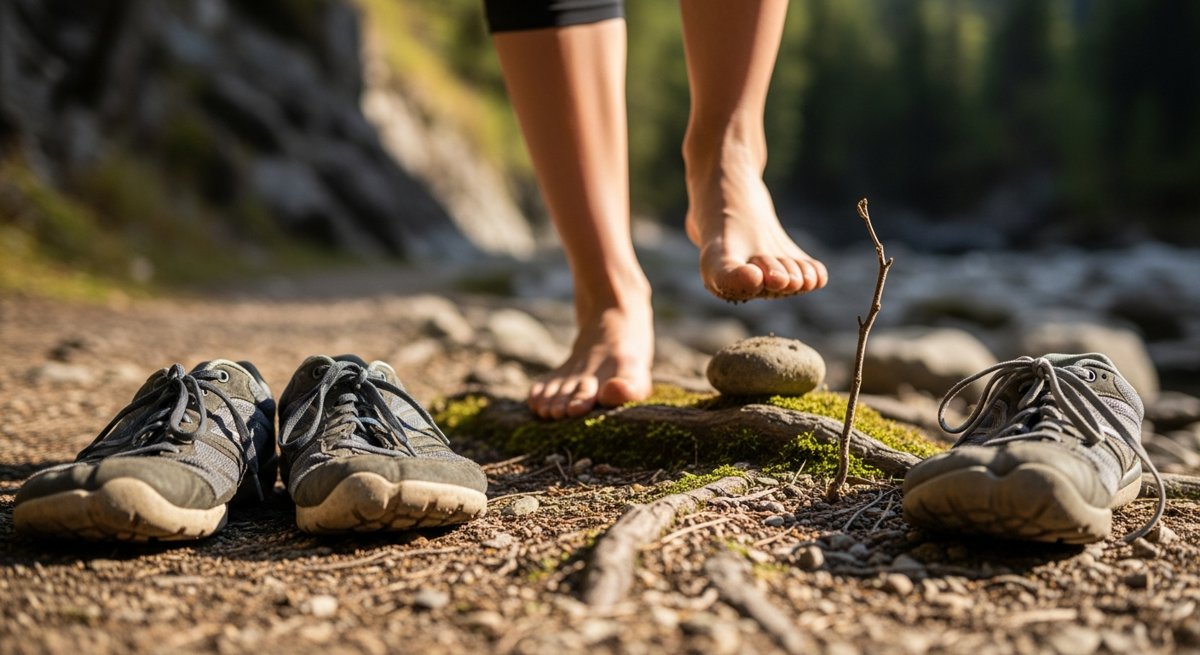
Look down at your feet. Right now. Those things at the end of your legs that hit the ground 7,000+ times a day, carry you through every workout, and absorb the entire weight of your existence — when was the last time you actually trained them?
Yeah. That is what I thought.
Here is the deal: your feet have 26 bones, 33 joints, and over 100 muscles, tendons, and ligaments — roughly a quarter of all the bones in your body. They are engineering marvels. And most of us have shoved them into padded coffins since we were toddlers, then wonder why our knees ache, our hips are tight, our balance is garbage, and plantar fasciitis hits us at 35 like a freight train.
This is not another “go barefoot and you will be enlightened” post. I am not telling you to throw out your boots and start running on gravel tomorrow. I am telling you something simpler and harder: your feet are weak, your shoes made them that way, and you can fix it. Here is how.
Why Your Shoes Are the Problem
Modern shoes are designed around three principles: cushion, support, and motion control. Sounds great, right? It is not. Here is what each one actually does:
- Cushion dampens the feedback your feet send to your brain about how to land. So you land harder. So they add more cushion. So you land harder still.
- Arch support does the work your foot intrinsic muscles are supposed to do — so those muscles atrophy, like any muscle a brace replaces.
- Motion control stops your foot from doing what feet are designed to do: spread, pronate, and act as a shock-absorbing spring.
A 2017 study in Nature (Holowka and Lieberman) compared habitually barefoot populations to shod ones. The barefoot group had significantly stronger arches, better balance, and dramatically lower rates of common foot pathologies. Not because their feet are magic. Because they actually use their feet.
My take? The shoe industry has spent 50 years selling you a solution to a problem they created. Your feet are not broken. They are untrained.
The 5-Minute Test: How Weak Are Your Feet?
Before you fix anything, let us see what we are working with. These four tests take five minutes total. No equipment.
Test 1: Single-Leg Balance (Eyes Closed)
Stand on one foot, close your eyes, start a timer. Goal: 30 seconds without your foot grabbing wildly at the floor. If you cannot make 10 seconds, your intrinsic foot muscles and proprioception are toast.
Test 2: Toe Spread
Sit down, look at your feet. Try to spread your toes like a fan — actively, no help from your hands. Big toe out, pinky toe out, gaps between every toe. Most adults can barely move their toes independently. That is not normal — that is atrophy.
Test 3: Arch Doming (Short Foot)
Stand. Without curling your toes, try to “shorten” your foot by pulling the ball of your foot toward your heel. Your arch should rise. If nothing happens, your tibialis posterior and intrinsics are offline. This is the muscle that creates your arch — not your shoe.
Test 4: Heel Raise Hold
Single-leg calf raise, hold the top position. Goal: 25 reps with a 2-second hold per side. Most people gas out at 8-10. Strong calves and feet share most of the same plumbing.
If you bombed all four — congrats, you are normal. And you have got room to grow.
The Daily 10-Minute Foot Reset
You do not need a program. You need a habit. Do this every morning while your coffee brews. Barefoot. On a hard floor. Ten minutes total.
1. Toe Spreads and Lifts (2 min)
Sit or stand. Lift only your big toe, keeping the others down. Then reverse — keep the big toe down, lift the other four. Then spread all toes wide and hold 5 seconds. This will feel impossible the first week. Do it anyway. The pathways come back fast.
2. Short Foot Holds (2 min)
Standing, dome your arch (test 3 above) and hold 10 seconds. Repeat 10 times per foot. This rebuilds your arch the way nature intended — actively, not passively. If you have been told you have flat feet, this is the single most important exercise in this article.
3. Calf Raises, Slow Tempo (3 min)
3 sets of 15. 3 seconds up, 3 seconds down. Both legs at first; progress to single-leg when you can hit 25 doubles cleanly. Edge of a step for full range. Your Achilles will thank you. Your knees will thank you. Your future self will thank you.
4. Single-Leg Balance (2 min)
30 seconds per side, eyes open. Then 30 seconds per side, eyes closed. Brush your teeth on one foot. Make coffee on one foot. Make balance a default mode, not an exercise.
5. Towel Scrunches (1 min)
Throw a hand towel on the floor. Scrunch it toward you using only your toes. Then push it back out. Boring? Yes. Effective? Stupidly so. The fastest way to wake up dormant intrinsics I have ever seen.
Real Talk: Should You Switch to Minimalist Shoes?
Maybe. But not the way most people do it.
Here is what happens 90% of the time: someone reads an article like this one, buys a pair of Vibrams, runs five miles in them on Saturday, and limps for two weeks with a metatarsal stress fracture. Your feet have been in casts for 30 years. You do not take a cast off and run a marathon.
My honest opinion after a decade of swapping in and out of minimalist footwear: spend more time barefoot at home, not less time in shoes outside. Take your shoes off the second you walk in the door. Walk around the yard barefoot in the morning. Do your foot work barefoot. Get a pair of zero-drop, wide-toe-box shoes for casual wear (Altra, Lems, Xero — pick one) and use them as your “training wheels” while you transition.
Save the running and lifting in barefoot shoes for after you can pass the four tests above. We will cover the actual transition protocol in Part 3 of this series.
What Happens When You Actually Do This
A few things, in roughly this order:
- Week 1-2: Your calves will be sore. Not pulled, not injured — just awake for the first time in a decade.
- Week 3-4: Balance improves measurably. You stop wobbling on the single-leg test. Stairs feel different.
- Month 2: Knee pain (if you had any) often quietly disappears. Knees inherit problems from feet and hips. Fix the feet, the knees relax.
- Month 3+: Your gait changes. You land softer. You feel the ground. You realize you have been numb from the ankles down your whole life.
I am not promising miracles. I am telling you what tens of thousands of athletes, runners, and physical therapists already know: foot strength is the most under-trained, highest-leverage muscle group in the body. Ten minutes a day. That is the whole ask.
The Challenge
For the next 30 days, do the 10-Minute Foot Reset every morning. No exceptions. No “I will start Monday.” Tomorrow morning, before coffee, on the kitchen floor.
Re-take the four tests on day 30. I bet you will double your single-leg balance time and add 10+ reps to your heel raises. Drop me a line and tell me what changed.
This is Part 1 of our Foot Mechanics series. Up next: how to choose between zero-drop, minimalist, and maximalist shoes — and why the spec sheet matters more than the marketing.
Your feet carried you for free your entire life. Pay them back with ten minutes a day.