

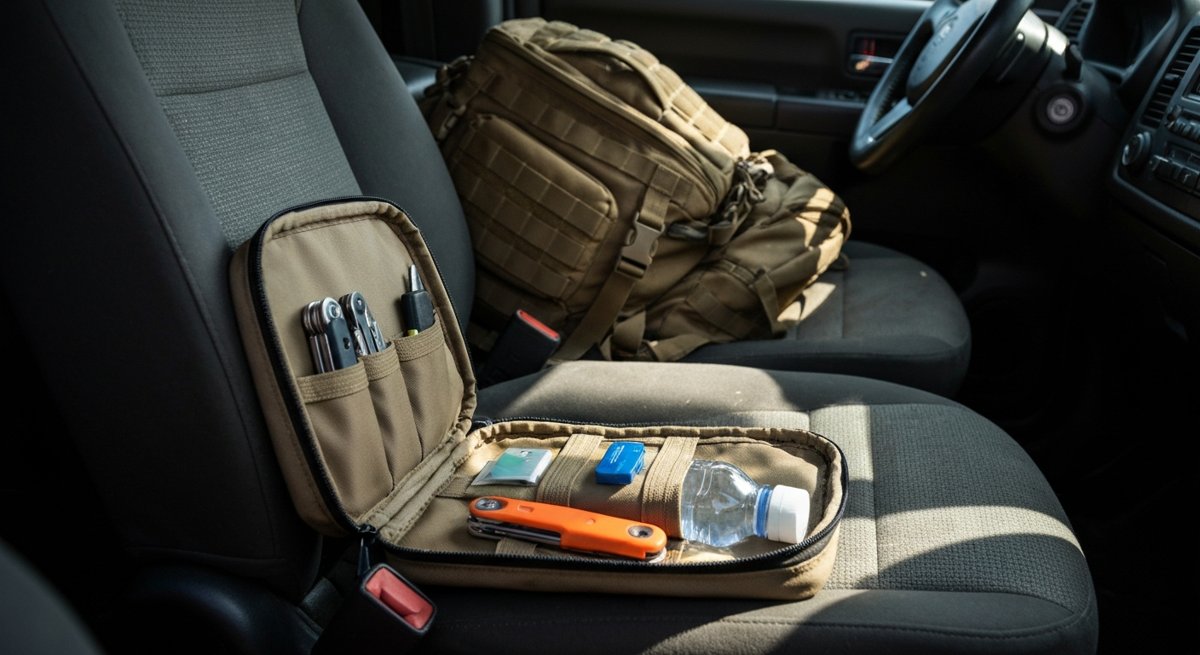
Here’s the pattern I see constantly: someone gets into preparedness, buys a massive tactical backpack, stuffs it with 40 pounds of gear, throws it behind the driver’s seat, and never touches it again. Six months later, the water’s expired, the batteries are dead, and they can’t find the one thing they actually need — a decent flashlight — because it’s buried under three MREs and a folding saw.
The problem isn’t the gear. It’s the approach. A vehicle EDC kit shouldn’t be a bug-out bag. It should be a curated, organized set of tools you actually reach for — on a regular Tuesday when you need to cut zip ties, charge a dead phone, or fix a flat in the dark.
Let me show you how to build one that works.
The Two-Tier System: Daily Reach vs. Emergency Backup
The key to a vehicle kit that actually gets used is splitting it into two layers:
Tier 1 — The Daily Reach Pouch. This is small. Think organizer pouch or glove-box insert. These are the items you grab weekly or even daily. They live within arm’s reach — center console, door pocket, or glove box.
Tier 2 — The Trunk Kit. This is your emergency layer. It stays packed and organized in a rigid container in your trunk or truck bed. You touch it monthly to rotate water and check batteries, but when you need it, you know exactly where everything is.
This separation is everything. When your daily-use items are mixed in with emergency gear, you stop reaching for any of it.
Tier 1: Your Daily Reach Kit (6 Items Max)
Constraint is the point here. If it doesn’t fit in an organizer the size of a large paperback, you’re overpacking this tier. Here’s what earns a spot:
1. A quality folding knife. Not a $200 collector piece you’re afraid to use. A solid, mid-range folder with a 3–3.5 inch blade that you’ll actually pull out to cut cordage, open packages, or strip wire. I like the Civivi Elementum or Ontario RAT II for this role — under $50, great steel, zero guilt using them hard.
2. A compact flashlight (600+ lumens). Not the 3,000-lumen tactical cannon. A single-cell 18650 or even AA light that fits in your hand, throws enough light to check under the hood or illuminate a trail at night. The sweet spot is 600–1,000 lumens with a low moonlight mode. Charge it when you charge your phone — make it a habit.
3. A USB charging cable and small power bank. Boring? Sure. But when your phone dies at 4% and you need maps, this is worth more than your fixed-blade collection. A 10,000mAh bank is plenty — charges most phones twice. Keep it topped off.
4. A pen and waterproof notepad. You’ll use these more than you think. Jotting down license plates, notes, measurements, phone numbers when your hands are too dirty for a touchscreen. Fisher Space Pen is the gold standard, but any metal-body pen works.
5. A lighter. Even if you don’t smoke. A simple Bic lighter is the most reliable fire source ever made and costs a dollar. Toss one in the pouch and forget about it until you need it.
6. Cash. $40–60 in small bills. Folded flat in the pouch. When the card reader’s down, the power’s out, or you need to tip someone for a jump start, cash is king. Don’t overthink this — just put it in there.
Tier 2: The Trunk Emergency Kit
This lives in a rigid container — a small plastic tote or ammo can, not a soft bag. Why? Because in your trunk, soft bags get crushed, shift around, and lose their shape. A rigid box stays organized and stackable.
Here’s what goes in it:
- Jumper cables or a lithium jump starter. The jump starter is better — it’s compact, works solo, and most double as a power bank. Worth the $60–80.
- Basic first aid kit. Not a field surgery kit. Band-aids, gauze, medical tape, ibuprofen, antihistamines, and a tourniquet if you’ve trained with one. If you haven’t trained with a tourniquet, skip it — gear you can’t use is dead weight.
- Two bottles of water. Rotate quarterly. Mark the date on the cap with a Sharpie.
- A rain poncho. One of those $3 emergency ponchos, still in the wrapper. Takes up zero space and turns a miserable roadside tire change into a merely annoying one.
- Work gloves. Mechanix or similar. Changing a tire, moving debris, handling broken glass — bare hands are a liability.
- A multi-tool. This is where your Leatherman or Gerber lives. Pliers, screwdrivers, a blade — the multi-tool is for problems that need more than a folding knife.
- Duct tape. Wrap 10 feet around an old gift card. Takes up almost no space, fixes almost anything temporarily.
- Reflective triangle or road flares. If you’re stopped on the shoulder at night, visibility is survival. Non-negotiable.
- A basic tow strap. 20-foot, 10,000lb rated. Not a bungee cord. Not a ratchet strap. An actual recovery strap. If you live anywhere with mud, snow, or ditches, this will save you a tow truck bill at least once.
The Part Everyone Skips: Maintenance
A kit you build and forget is a kit that fails when you need it. Set a quarterly reminder — first day of each season works great. Takes five minutes:
- Check water expiration. Replace if needed.
- Test the flashlight and jump starter. Charge both.
- Verify the power bank has charge.
- Check the first aid kit — anything used? Replace it.
- Cash still there? (Seriously. It walks.)
That’s it. Five checks, five minutes, four times a year.
What NOT to Put in Your Vehicle Kit
This is where I’ll get some pushback, but here’s my honest take on what doesn’t belong:
- MREs or heavy food. They take up too much space, they’re affected by heat, and unless you’re driving through the Nevada desert for 12 hours, you don’t need them. A couple of granola bars in Tier 2 is fine. Anything more is cosplay.
- Weapons beyond your folding knife. Your vehicle kit is for roadside problems and minor emergencies. If personal defense is a priority, that’s a separate, dedicated decision — not something to lump in with your jumper cables.
- Survival blankets as your only warmth layer. Those crinkly mylar blankets are better than nothing, but only barely. If you live somewhere cold, keep an actual fleece blanket or jacket in the trunk. It doubles as a picnic blanket the other 11 months.
- Anything you haven’t tested. That fire starter kit you bought? Have you used it? The water filter straw? Ever actually drunk through one? Don’t carry gear you can’t operate under stress. Period.
The Takeaway
The best vehicle EDC kit isn’t the biggest one. It’s the one you actually use, actually maintain, and can actually find things in when it’s dark, raining, and your hands are shaking.
Build it in two tiers. Keep the daily stuff within reach. Keep the emergency stuff organized in a rigid box. Review it quarterly. Done.
Your challenge this week: Pull everything out of your vehicle right now — glove box, center console, trunk, under the seats. Lay it all out. How much of it is actually useful? How much is junk drawer overflow? Rebuild it with intent. Two tiers. Six items max for Tier 1. One rigid box for Tier 2. Report back.