

Let me save you about $400 a year. Walk into any supplement store and you’ll see walls of powders promising you everything from “explosive pumps” to “alpha test boosting.” Ninety-five percent of it is hopium in a plastic tub. There is, however, one supplement that has been studied to death for forty years, costs about thirteen cents a day, and actually does what it says. That’s creatine.
I’ll cut to the chase: I take it. My wife takes it. My 60-year-old dad takes it. If you train, lift heavy things, ruck, or just want to age without turning to dust, creatine should already be in your kitchen. If it’s not, you’re being weird about the easiest win in fitness.
What Creatine Actually Is
Creatine isn’t some lab-made chemical from a Russian doping lab. Your body already makes about a gram of it per day in your liver and kidneys, and you pull another gram or two out of red meat and fish. It lives inside your muscle cells where it does one job: donate a phosphate group to ADP, recycling it back into ATP — the molecule that fuels short, hard efforts.
Translation: more creatine in your muscles = more juice in the tank for sets 3, 4, and 5. That’s it. That’s the magic. It’s not a stimulant. It’s not a hormone. It’s a battery that lets you do one or two more reps, which over weeks and months compounds into noticeably more muscle and noticeably more strength.
What the Research Actually Shows
Creatine monohydrate is the most studied sports supplement in human history. Not “most marketed” — most studied. Over 1,000 peer-reviewed trials. The consensus is boring and consistent:
- 5–15% increase in strength over 4–12 weeks compared to placebo.
- 1–2 kg of lean mass in the first month (some is water inside the muscle cell — that’s fine, that’s also performance).
- Better high-intensity work capacity — more reps, more sets, faster recovery between them.
- Cognitive benefits in sleep-deprived and aging populations — improved working memory and reaction time.
- Potential neuroprotective effects — promising work in Parkinson’s, depression, and traumatic brain injury, though not conclusive yet.
It’s also one of the safest supplements ever tested. The “creatine destroys your kidneys” myth refuses to die, but if you actually look at the literature you’ll find decades of studies in healthy adults showing zero kidney impact at standard doses. If you have existing kidney disease, talk to your doctor. Everyone else: you’re fine.
Which Type to Buy (Hint: The Cheap One)
Supplement companies have invented at least a dozen “advanced” forms of creatine — HCL, ethyl ester, buffered (Kre-Alkalyn), nitrate, magnesium chelate. They charge two to four times more for them. And in head-to-head trials, every single one of them either performs the same as plain old creatine monohydrate, or worse.
Buy creatine monohydrate. That’s it. If you want to be extra picky, look for “Creapure” on the label — it’s a German-manufactured form with the highest purity certification. A 1 kg tub costs around $30 and lasts six to eight months. That’s roughly 13 cents per day.
Don’t pay $50 for “next-gen pH-optimized hydro-soluble” creatine. The molecule that gets absorbed into your muscle cell is the same either way. It’s literally just marketing with a metallic label.
How to Actually Take It
This is where people overcomplicate the simplest supplement on Earth. Here’s the entire protocol:
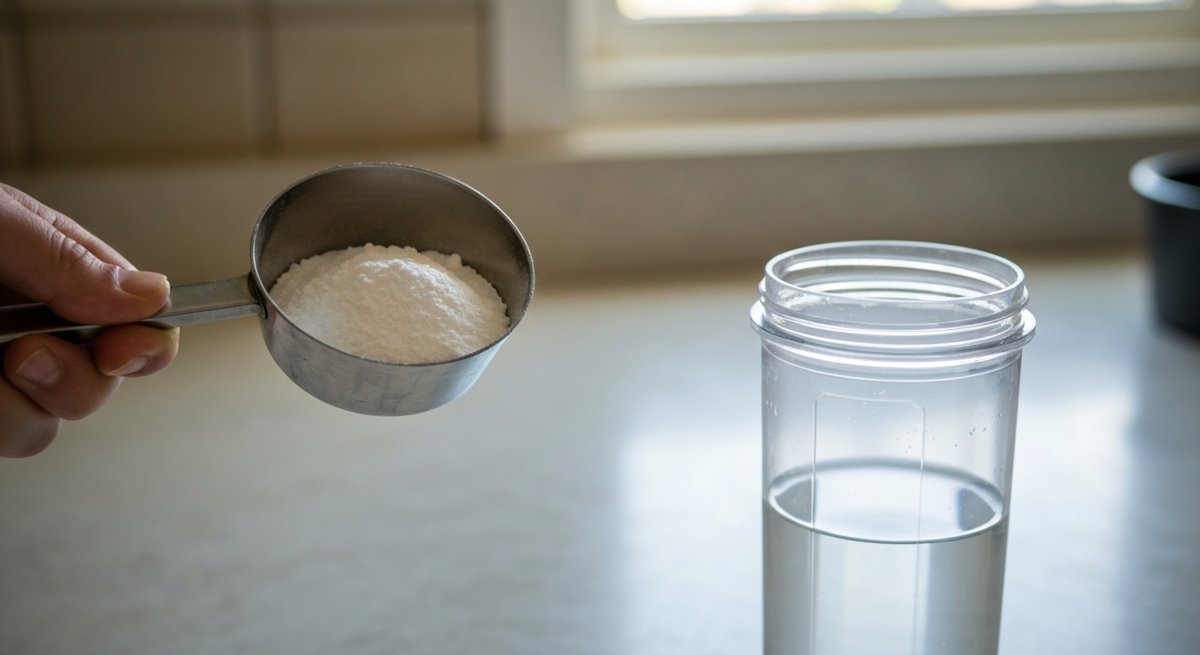
The dose: 5 grams per day. One rounded teaspoon. Every day. Forever.
The timing: Doesn’t matter. Morning coffee, post-workout shake, with dinner — muscle storage builds up over weeks. One missed day means nothing.
The liquid: Water, coffee, juice, protein shake. Doesn’t matter. The “creatine and caffeine cancel out” myth was based on one flawed 1996 study and has been debunked dozens of times since.
Do You Need to “Load”?
Old-school protocols had you slam 20 g/day for 5–7 days to saturate your muscles fast, then drop to 5 g maintenance. It works. It also gives some people stomach upset, and the only thing you gain is reaching full saturation in one week instead of three to four. Same destination, different on-ramp.
If you’re impatient, load. If you’re not, don’t. The end result is identical after a month.
Do You Need to Cycle Off?
No. Your body doesn’t “downregulate” creatine production in any way that comes back to bite you. Take it daily, year-round. Stop only if you stop training and don’t care about the cognitive benefits.
What to Expect (and What’s Hype)
Real, expected effects in weeks 2–8:
- Your last few reps feel crisper. You’re getting an extra rep or two on heavy sets.
- Muscles look slightly fuller — that’s intracellular water, which is exactly what you want.
- Recovery between sets is noticeably better. Less gasping during a 4×8 squat session.
- Scale might go up 1–3 lbs in the first two weeks. That’s water in muscle. Not fat.
Stuff creatine does NOT do:
- Make you bloated or “puffy” in the face. It goes into muscle, not under your skin.
- Cause hair loss. One small 2009 rugby study suggested a DHT bump and the internet ran with it. Never replicated.
- Replace training. You still have to lift the bar.
- Turn you into a different human. It’s a 5–15% edge, not a steroid.
Who Should Be Taking This
Honestly? Almost everyone over 30 who moves their body for a living or a hobby.
- Lifters and athletes: Obvious. This is what it was made for.
- Ruckers, hikers, manual laborers: Anything with repeated hard efforts benefits.
- People over 50: Sarcopenia — age-related muscle loss — is brutal. Creatine plus resistance training is the best one-two punch we have for it.
- Vegetarians and vegans: You make less endogenous creatine because you don’t eat meat. You’ll feel the difference more than anyone.
- Anyone chronically sleep-deprived: Parents, shift workers, students. There’s solid evidence creatine helps cognitive performance under sleep deprivation.
The only “maybe skip it” case is a competitive endurance athlete worried about a small water-weight gain affecting power-to-weight ratio. For everyone else, the cost-benefit is absurd.
The Common Mistakes I See
- Stopping after two weeks because “it didn’t work.” Saturation takes 3–4 weeks without loading. Be patient.
- Buying flavored creatine blends. You’re paying 3x for sugar and dye. Buy plain monohydrate and mix it with whatever you already drink.
- Taking it only on workout days. Saturation is a steady-state thing. Daily, including rest days.
- Drinking 4 liters of water “to support kidney function.” Drink normal amounts of water. Your kidneys are not in danger.
- Doubling up after missing a day. Unnecessary. Just take your 5 g and move on.
My Honest Take
I’m cynical about the supplement industry. Most of it is overpriced placebo dressed up with sponsored athletes who’d look exactly the same without it. Creatine is the exception. It’s the one bottle on my counter that has earned its spot through forty years of replication, not marketing budget.
Five grams. Every day. About thirty dollars every six months. If you train and you’re not on it, you are leaving free strength, free recovery, and probably some free cognition on the table for no reason at all.
Your Challenge This Week
Buy a 1 kg tub of plain creatine monohydrate (Creapure if you can find it, any reputable brand if not). Put it next to your coffee maker. Take 5 grams every morning for the next 30 days alongside your training.
If you don’t notice a difference in the gym by week four, I’ll be genuinely surprised. And if you do — welcome to the boring, effective side of supplementation.
Not medical advice. If you have kidney disease, are pregnant, or are under 18, talk to your doctor first. Everyone else: it’s just creatine, relax.