

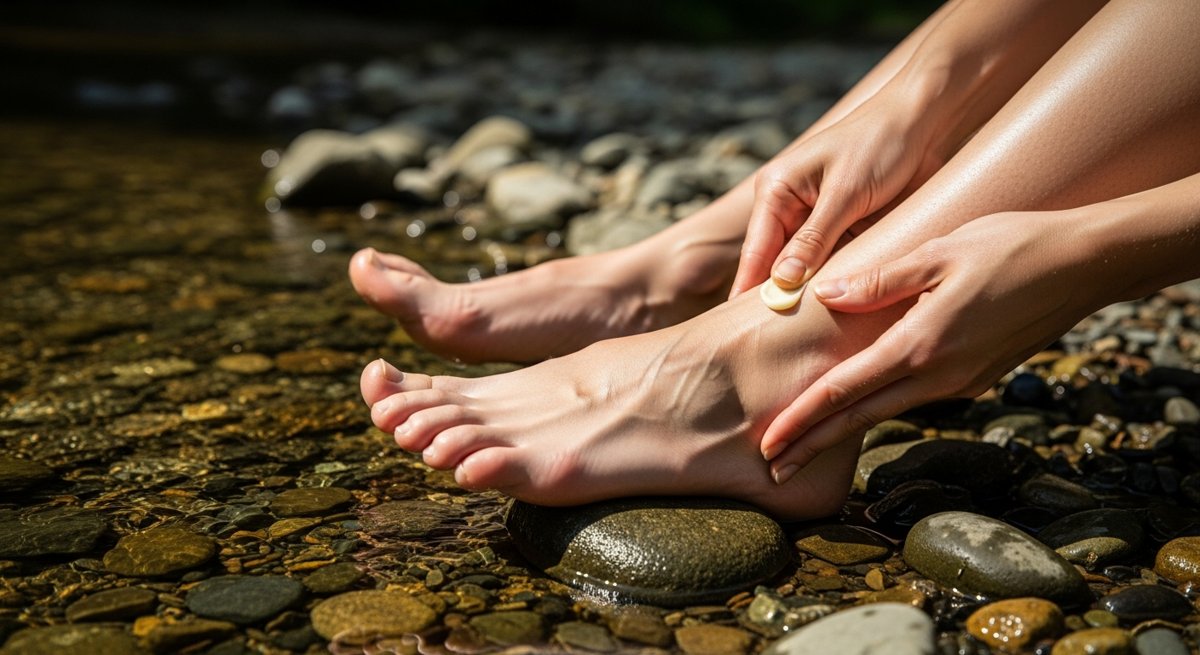
You stretch your hamstrings. You foam roll your back. You ice your knees. And then you cram the two most abused structures in your body — your feet — back into shoes and forget about them until the next hard day. That’s backwards. Your feet take roughly the impact of your bodyweight a few thousand times every mile, and they’re the foundation everything else stands on. Recover them properly and your knees, hips, and lower back all thank you. Ignore them and you’re building recovery on a cracked slab.
This is Part 5 of the Foot Mechanics series. We’ve talked about why your feet got weak, how to transition to less shoe, and how to come back to running without wrecking your knees. Now let’s talk about the part everybody skips: what your feet actually need after the work is done.
Why Your Feet Need Active Recovery (Not Just Rest)
Here’s the thing nobody tells you: your feet have 26 bones, 33 joints, and over 100 muscles, tendons, and ligaments crammed into a space the size of a paperback. After a long ruck, a hard run, or eight hours on concrete, all that tissue is jammed up, the small intrinsic muscles are fatigued, and the plantar fascia — the thick band of connective tissue along the bottom of your foot — is tight and irritated.
Passive rest helps, but it’s slow. Active recovery — deliberately mobilizing, releasing, and stretching the tissue — flushes blood through the area, breaks up adhesions, and resets resting muscle tone so you wake up loose instead of stiff. My honest opinion after years of this: ten minutes of foot work beats an hour on the couch every single time. It’s the highest return-on-time recovery move there is, and almost nobody does it.
Step 1: Roll the Bottom of Your Foot
Start where the abuse lands hardest — the sole. Grab a firm ball (a lacrosse ball is the gold standard; a golf ball if you want it more aggressive), put it under your bare foot, and roll slowly from heel to the ball of the foot for 60-90 seconds per side. Stand for more pressure, sit for less. When you hit a knot, park on it and breathe for a few seconds until it releases.
This single move is the best thing you can do for tight, achy arches and early plantar fasciitis. A dedicated massage ball holds up better than a golf ball and won’t roll away on you — Power Systems’ foam roller and massage ball collection has lacrosse balls, textured myo-release balls, and trigger-point tools in the $4-15 range. Cheap insurance for your feet.
Pro move: keep a ball in the freezer. Rolling with a frozen ball after a brutal day gives you the massage and the ice in one shot, which is exactly what an inflamed plantar fascia wants.
Step 2: Work the Calves and Lower Legs
Your feet don’t operate alone. Tight calves pull on the heel and load the plantar fascia, so foot recovery that ignores the lower leg is half a job. Drop onto a foam roller and work the calf from the achilles up to behind the knee — 30-45 seconds each side, then turn the leg slightly in and out to hit the inner and outer heads. Add the shins (the front) if you’re a runner; tight tibialis muscles are a quiet cause of shin splints.
A firm grid-pattern roller digs in better than the soft cylinders. The TriggerPoint GRID Foam Roller, 13-Inch, Black is the one I keep recommending — it’s compact enough to throw in a gym bag and firm enough to actually do something. Follow the rolling with a wall calf stretch: hands on the wall, one leg back, heel down, lean in for 30 seconds, then bend the back knee to shift the stretch into the lower calf and achilles.
Step 3: Mobilize the Toes and Ankles
Shoes hold your toes in a coffin all day. Recovery is when you give them room to move again. Three drills, no equipment:
- Toe spreads: sit barefoot and actively splay your toes apart, hold 2 seconds, release. 20 reps. If they won’t move independently, weave your fingers between them and stretch them manually first.
- Ankle circles: 15 slow circles each direction, each foot. Boring, but it restores the rotation your stiff ankles lost.
- Big-toe pulls: grab your big toe and gently pull it back toward your shin, then point it down. This restores the toe extension you need for a normal push-off and walking gait.
Step 4: Strengthen What You Just Loosened
Recovery isn’t only about releasing tissue — it’s the perfect window to fire up the small muscles that keep your arch from collapsing. Two of my favorites:
- Towel scrunches: lay a towel flat on the floor, plant your heel, and use your toes to drag the towel toward you. 2-3 rounds. You’ll feel muscles in your arch you forgot you had.
- Banded foot work: loop a resistance band around your forefoot and work ankle flexion, extension, and side-to-side. Cheap, packable, and brutal in the best way. A set like the Fit Simplify Resistance Loop Exercise Bands, Set of 5 covers feet, ankles, hips — the whole lower-body chain — for the price of a sandwich.
Don’t overthink the load. The intrinsic foot muscles respond to frequency, not heroics. A little, often, beats a once-a-week beatdown.
Step 5: What You Put on Your Feet After Counts Too
Two ways to win here. First, go barefoot around the house for 20-30 minutes post-workout — let the foot articulate, splay, and grip on the floor the way it was built to. That barefoot time is recovery.
The Big Guns: Contrast, Elevation, and Salt
For genuinely thrashed feet — marathon, all-day ruck, double shift — pull out the extras:
- Contrast soak: alternate 1 minute hot, 1 minute cold, 3-4 rounds, end on cold. The vascular pumping flushes swelling better than ice alone.
- Elevation: 10 minutes with your feet above your heart. Gravity does the de-swelling for free.
- Epsom salt soak: the science on magnesium absorption is thin, but a warm soak relaxes the tissue and feels like a reward. That’s enough reason.
Your 8-Minute Daily Foot Recovery Protocol
- Roll each sole with a ball — 60 sec/side
- Foam roll calves — 45 sec/side
- Wall calf stretch — 30 sec/side (straight + bent knee)
- Toe spreads — 20 reps
- Towel scrunches — 2 rounds
- Ankle circles — 15 each direction
That’s it. Eight minutes. Do it for two weeks and your feet will feel like a different set of equipment.
The Takeaway
Your feet are the only part of your body in contact with the ground, and they’re almost always the most neglected link in your recovery chain. You don’t need a fancy boot or a $600 massage gun. You need a firm ball, a foam roller, a band, and eight honest minutes a night.
The challenge: run the 8-minute protocol every night for the next 14 days. No skipping. At the end, stand up first thing in the morning and notice how your first ten steps feel compared to today. That difference is the whole point — recovery built from the ground up.