

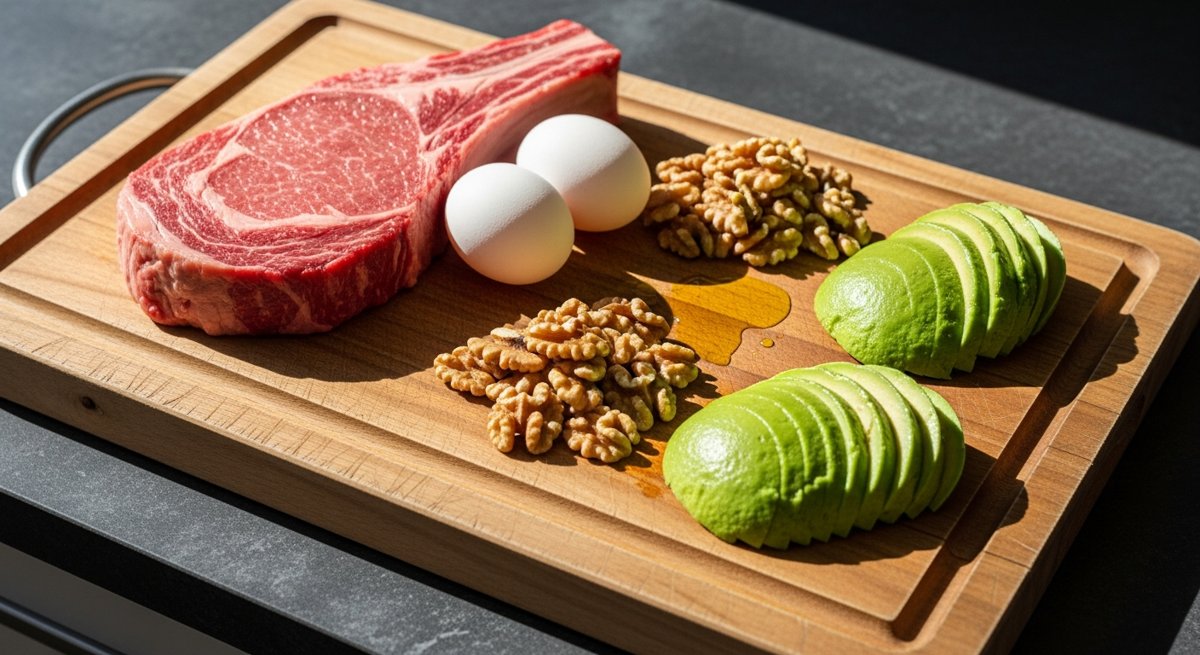
Walk into any gym parking lot and you’ll hear it: one guy swears he dropped 40 pounds eating nothing but ribeyes, the other guy hasn’t touched a carb since 2022 and won’t shut up about ketones. Carnivore and keto are the two loudest diets in the room right now, and people treat them like rival religions. They’re not. They’re two tools that work for the same reason — and understanding why is the thing that actually gets you lean.
Let me save you a year of confusion. Here’s what’s real, what’s marketing, and what to actually do.
The Quick Definitions
Keto (ketogenic diet): Very low carb — usually under 50g a day, often under 20g — with moderate protein and high fat. The point is to push your body into ketosis, where it burns fat for fuel instead of glucose. You can still eat plants: avocados, leafy greens, nuts, olive oil, cheese.
Carnivore: Animal products only. Meat, eggs, fish, some dairy. Zero plants. It’s keto’s stricter, more extreme cousin — carbs naturally fall to almost nothing because you’re not eating anything that contains them.
Both are low-carb. Both will put most people in ketosis. The real difference is just how many foods you’re allowed to eat.
Here’s the Part Nobody Wants to Hear
Neither diet has a magic metabolic advantage for fat loss. I know that’s not what the YouTube thumbnails promise. But when researchers actually control for calories and protein in a metabolic ward — meaning they lock people in and measure everything — low-carb and higher-carb diets produce nearly identical fat loss. The “ketosis burns more fat” claim falls apart fast once calories are matched.
So why do so many people lose weight on these diets? Three boring, undeniable reasons:
- You cut out entire food categories. No bread, no chips, no soda, no ice cream. That’s a massive calorie reduction by default, before you ever count a single macro.
- Protein and fat are filling. A ribeye keeps you full for hours. A bagel makes you hungry by 10am. When you’re less hungry, you eat less without trying.
- Eating gets simple. Fewer choices means fewer impulse decisions. “Meat and eggs” is a lot harder to overeat than a pantry full of snack foods engineered to be irresistible.
That’s it. That’s the whole trick. Both diets work by creating a calorie deficit you can actually stick to. The deficit is the engine. The diet is just the car you drive it in.
Carnivore: The Honest Pros and Cons
What it’s genuinely good at: Simplicity and appetite control. There’s nothing to track, nothing to weigh, no decisions. A lot of people with autoimmune issues, gut problems, or food sensitivities report real relief on carnivore — probably because an elimination diet this aggressive removes whatever was triggering them. For some folks, that’s life-changing.
Where it bites you: It’s socially brutal (try explaining it at a backyard cookout), it can get expensive if you’re eating quality meat, and the long-term data simply doesn’t exist. We don’t have decades of research on people eating zero plants. You’re also waving goodbye to fiber and a wide range of micronutrients. Some people thrive; others get constipated, irritable, and bored within three weeks.
My honest take: Carnivore is a fantastic short-term reset or diagnostic tool. If you suspect food is wrecking your gut, eliminating everything and slowly adding foods back is legit. As a forever diet? I’m skeptical. Restriction that extreme is hard to sustain, and “hard to sustain” is how every diet eventually fails.
Keto: The Honest Pros and Cons
What it’s genuinely good at: Steady energy and crushing cravings once you’re adapted. It’s more flexible than carnivore — you still get vegetables, fiber, and a broader nutrient base. There’s solid evidence for keto helping with blood sugar control and certain medical conditions (it was literally developed to treat epilepsy). For people who are insulin resistant, the appetite suppression can feel like a superpower.
Where it bites you: The transition sucks. “Keto flu” — headaches, fatigue, brain fog — hits a lot of people in the first week, mostly from dropped electrolytes. It’s also easy to do badly: people drown everything in cheese and butter, blow past their calorie needs on fat alone, and wonder why the scale won’t move. Fat is calorie-dense. You can absolutely eat too much of it.
My honest take: Keto is the more practical of the two for most people. It’s sustainable enough to live on, flexible enough to stay social-ish, and the cravings control is real. The catch is you have to actually keep carbs low — “lazy keto” where you eat 80g of carbs isn’t keto, it’s just a vague low-carb diet with a cooler name.
So Which One Should You Pick?
Stop asking which diet is “better” and start asking which one you’ll actually do. That’s the only question that matters. Here’s my decision tree:
- You want structure and hate counting? Keto. Hit your carb limit, eat real food, you’re golden.
- You have gut issues or suspect a food sensitivity? Try carnivore for 30 days as an elimination test, then reintroduce foods one at a time.
- You love variety and a social food life? Honestly, neither. A high-protein, moderate-carb diet with a calorie target will get you just as lean and you won’t have to bail on every dinner invite.
- You’ve failed every diet before? Pick the one with fewer rules you’ll break. For most people that’s keto, but if decision fatigue is your enemy, carnivore’s brutal simplicity might be the unlock.
The Stuff That Actually Determines Your Results
Whichever you choose, these four things matter more than the carnivore-vs-keto label:
- Protein, always. Aim for roughly 0.7–1g per pound of goal bodyweight. Protein protects your muscle while you lose fat. Both diets make this easy — don’t skip it.
- Electrolytes. Low-carb dumps water and sodium fast. Salt your food, get potassium and magnesium, and 90% of “keto flu” disappears. This is the single most ignored fix.
- Real calorie awareness. You don’t have to count forever, but at least know roughly what you’re eating for a week. Fat bombs and “keto treats” are how people stall.
- Sleep and consistency. A perfect diet on 5 hours of sleep loses to a decent diet on 8. Boring, but true.
One more practical note: both diets live or die in the kitchen. Eating this much meat means you’ll be cooking a lot more of it yourself, and a good cast iron skillet plus a decent instant-read meat thermometer will do more for your adherence than any supplement. These are the two pieces of kit worth buying once and never replacing.
The Bottom Line
Carnivore and keto both work, and they both work for the exact same reason: they make it easy to eat less without feeling starved. There’s no secret fat-melting magic in either one. Pick the version you can run for six months without white-knuckling it, nail your protein and electrolytes, and stay consistent. That beats the “perfect” diet you quit in three weeks every single time.
Your challenge this week: Pick one — keto or a 30-day carnivore test — and commit to a single non-negotiable rule: hit your protein target every day and salt your food. Run it for seven days, no cheating, and write down how your hunger and energy feel by Sunday. You’ll learn more about your own body in one honest week than from a hundred hours of diet debates online.