

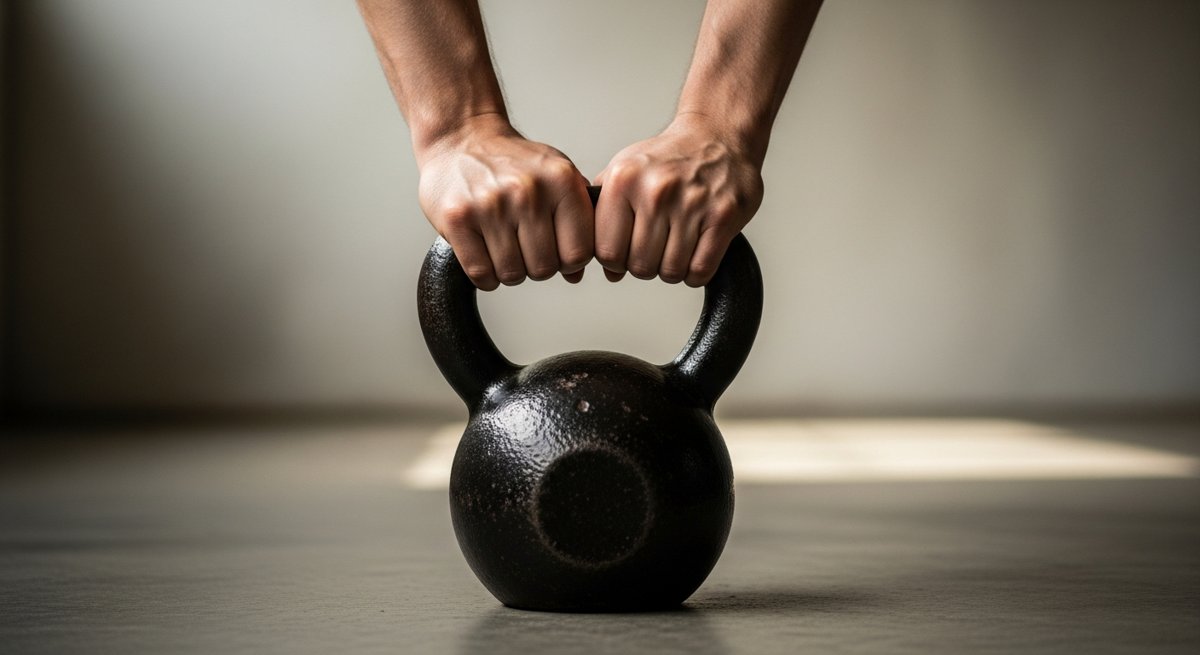
Here’s the pitch nobody in the fitness industry wants to make: you can build serious full-body strength and conditioning with one piece of equipment, in your garage, in 20 minutes. No squat rack. No membership. No drive. Just a hunk of cast iron with a handle.
The kettlebell complex is how you do it. And once it clicks, you’ll wonder why you ever paid $60 a month to wait for a bench.
What’s a “Complex,” and Why Should You Care?
A complex is a sequence of exercises you flow through back-to-back, without putting the bell down, for a set number of reps each. You do the whole chain, rest, repeat. Because you never set the weight down, your grip, core, and lungs get hammered while your muscles do the actual lifting. It’s strength and cardio in the same breath — which is exactly why it replaces about 80% of what most people do at a commercial gym.
I’ll be straight with you: this is harder than it looks on paper. The first time you string these together, a “light” bell will feel like it doubled in weight by round three. That’s the point. That’s the workout doing its job.
The One Piece of Gear You Need
You need exactly one kettlebell. Not a set. One. The trick is picking the right weight — heavy enough to challenge your strongest movement (the swing), light enough that you can still press it overhead without your form falling apart.
- Most men: start at 16 kg (35 lb).
- Most women: start at 8–12 kg (18–26 lb).
- Already strong / lifting regularly: 20–24 kg.
Buy cast iron with a smooth, single-piece handle — no welds, no chrome that’ll chew up your hands during a swing. I’m partial to a solid cast-iron kettlebell from Power Systems; their gym-grade bells have the wide, comfortable handle that makes high-rep work bearable. If you want one bell to grow into, the Power Systems Elite Kettlebell is the kind of thing you buy once and hand down. Skip the adjustable plastic-shell ones — the balance is wrong and the handle’s too fat for cleans.
The 20-Minute Complex
Here’s the whole workout. Five movements, done in order, without setting the bell down between them. This is one “ladder.” You’ll do it on each side.
The Sequence (per side)
- 5× Clean — swing the bell up to the rack position (resting on your forearm at the shoulder).
- 5× Front Squat — bell stays racked, you squat.
- 5× Press — press the bell straight overhead.
- 5× Reverse Lunge — bell still racked, step back into a lunge.
- 5× Swing — finish by setting it down to two hands and swinging to chest height.
That’s 25 reps on the right, then immediately 25 on the left. Set the bell down. That’s one round. Rest 60–90 seconds. Repeat for as many rounds as you can hold good form inside 20 minutes — most people land between 4 and 7 rounds.
How to Actually Run It
Week 1–2: Learn the Moves
Forget the clock. Do the sequence slowly with a comfortable weight. Film yourself from the side on the swing and the press — those are where people get hurt. The swing is a hip hinge (think slamming a car door with your butt), not a squat or an arm raise. The bell floats up because your hips snap, not because your shoulders lift it.
Week 3–4: Add the Clock
Now set a 20-minute timer and count your rounds. Write the number down. That number is your benchmark — beating it is the entire game from here on out.
Week 5+: Progress
You progress one of three ways, in this order: more rounds in the 20 minutes, then shorter rest, then a heavier bell. When you can crank out 7+ clean rounds with short rest, it’s time to size up. This is why a single heavier bell eventually earns its place — but earn it first.
Why This Beats the Gym for Most People
- Time. Door to done in 25 minutes including warm-up. No commute, no waiting on equipment.
- Everything at once. Legs, back, shoulders, grip, core, and a brutal cardio effect — one tool, one session.
- It travels. Throw the bell in the truck for a hunting camp or a job site. Try that with a leg-press machine.
- It’s honest. You can’t half-ass a kettlebell complex. The bell tells you the truth about your conditioning real fast.
Is it a complete replacement for a powerlifter chasing a 500 lb deadlift? No. But for the 95% of us who want to be strong, lean, hard to kill, and useful — it’s more than enough. I’d argue it’s better, because the workout you do beats the perfect workout you skip.
Your Challenge This Week
Get one bell. Today if you can. Spend two sessions just learning the five moves — no clock, no ego. Then on session three, set the 20-minute timer and count your rounds. Write that number on the bell with a paint pen if you have to.
Four weeks from now, you’ll be doing more rounds, resting less, and looking at that commercial gym membership like the subscription you forgot you were paying for. Pick up the iron. Let’s go.