

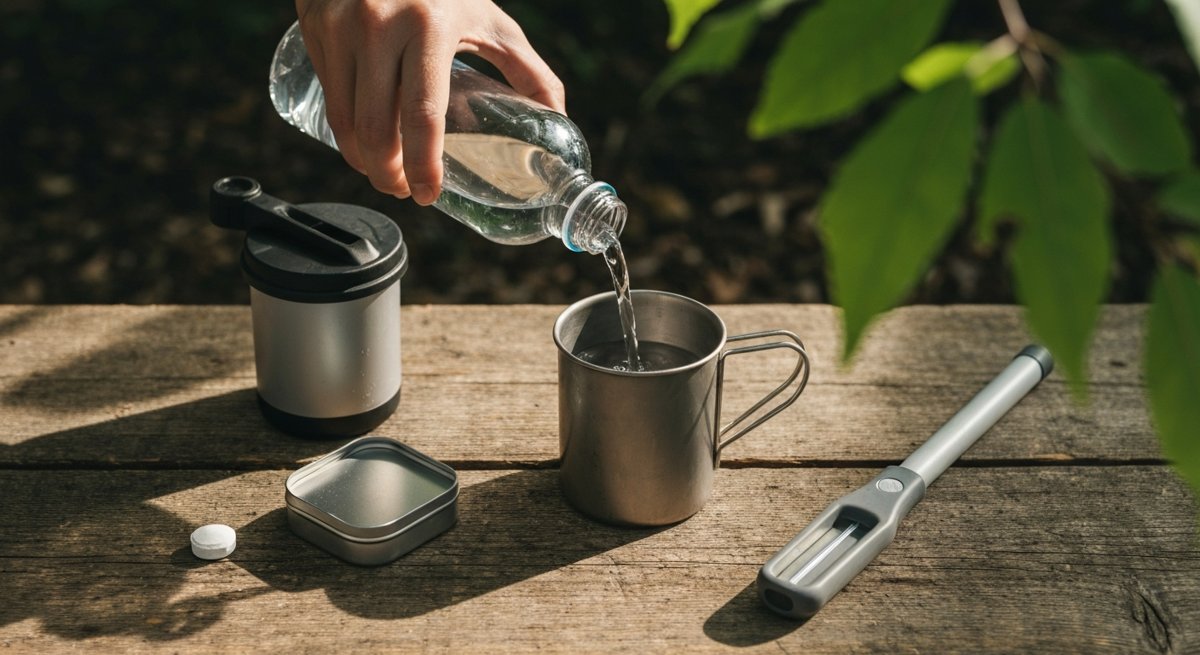
You can survive about three days without water. But here’s the part most people miss: drinking the wrong water can kill you faster than dehydration. Giardia. Cryptosporidium. E. coli. Norovirus. Heavy metals from old mining runoff. A clear mountain stream looks like Evian and tastes like betrayal.
So you boil it, right? Sometimes. Sometimes you can’t. Sometimes you’re moving fast, your fuel is wet, and you’ve got 800 mL of unknown creek water and 20 minutes before you need to be five miles down the trail. That’s why you need to actually understand your options — not just own a Sawyer because some YouTuber said so.
Here’s the honest ranking of the four main field methods, what each one actually kills, and when I’d reach for each one.
The Four Methods, Ranked Overall
- Boiling — most reliable, requires fuel + time
- Filtration (hollow fiber) — fastest in the field, no waiting
- Chemical tablets — lightest, slowest, tastes awful
- UV light — fast and clean, but fragile and battery-dependent
That’s the headline. Now let’s get into the why — because the right answer depends entirely on what you’re worried about.
#1. Boiling — The Gold Standard
Kills: Bacteria. Viruses. Protozoa (giardia, crypto). All of it. Anything biological dies in a rolling boil.
Does NOT remove: Chemicals, heavy metals, salt, sediment, or the taste of dead leaves.
How long: CDC says one minute at a rolling boil at sea level. Three minutes above 6,500 ft. That’s it. The “boil it for ten minutes” thing is folklore — by the time water hits 160°F, you’ve already killed everything that matters.
Why it wins: No moving parts. Nothing to break. Nothing to replace. If you have a pot and a heat source, you have safe water. Forever.
Why it loses sometimes: Fuel is heavy. Time is expensive. You can’t boil while you’re hiking. And in a true emergency — say, urban evac, no power — you might not have a stove at all.
My take: If I’m in a basecamp with a fire going, boiling is always the answer. It’s the most foolproof method humans have ever come up with. The only reason it’s not #1 in your pack is that it’s slow and fuel-dependent.
#2. Hollow-Fiber Filters — The Field Workhorse
The standouts: Sawyer Squeeze, Sawyer Mini, Katadyn BeFree, MSR Trail Shot.
Kills/removes: Bacteria and protozoa — 99.9999% of the bad stuff at the 0.1-micron level. The Sawyer Squeeze is rated to 100,000 gallons. That’s a lifetime of water from one filter the size of your thumb.
Does NOT remove: Viruses. This matters. In North America? Almost never an issue — viral contamination of backcountry water is extremely rare. In a sewage-contaminated urban flood, or anywhere overseas? You need more than a filter.
Why it wins: Drink immediately. No waiting, no taste, no fuel. Lightweight. Cheap (Sawyer Squeeze is around $40). Works in dirty water as long as you backflush it.
Why it loses sometimes: Freezing kills hollow-fiber filters. One night below 32°F with water still in the fibers and the filter is silently destroyed — no warning, just contaminated water next time. You also can’t filter saltwater or chemical contamination.
My take: This is what lives in my pack. Every hike, every overnight, every truck kit. The Sawyer Squeeze is the most cost-effective survival item I own. Just don’t let it freeze.
#3. Chemical Tablets — The Ultralight Backup
The standouts: Aquatabs (chlorine dioxide), Potable Aqua (iodine), Katadyn Micropur.
Kills: Chlorine dioxide tablets kill bacteria, viruses, AND crypto — which is rare for a single method. Iodine kills most things but is weak against crypto.
How long: 30 minutes for bacteria/viruses. Four hours for crypto in cold water. That’s the catch.
Why it wins: Weighs nothing. Lasts years on the shelf. Zero moving parts. Doesn’t care if it freezes. Throws into any kit and forgets about it until you need it. Pack of 30 tabs costs about $13.
Why it loses sometimes: Slow. Tastes like a pool. Doesn’t remove sediment. Iodine is contraindicated for pregnant women and people with thyroid issues. The wait time when you’re parched is brutal.
My take: Tablets are not your primary. They’re the redundancy. They live in the lid pocket of my pack and in my truck kit because they weigh nothing and they don’t break. If your filter freezes or clogs at the worst moment, the tablets save you.
#4. UV Light — Cool Tech, Wrong Tool
The standouts: SteriPEN Ultra, SteriPEN Adventurer Opti.
Kills: Everything biological — bacteria, viruses, protozoa. UV-C light scrambles their DNA and they can’t reproduce.
Why it wins on paper: 90 seconds, no chemicals, no flavor, no fuel.
Why it loses in reality: It’s a glass UV bulb in a battery-powered electronic device that you’re going to dip into cold water and toss around in a pack. The failure modes are not theoretical. Bulb breaks. Batteries die. Electronics get wet. Water must be clear — turbid water blocks the UV from reaching the pathogens, and you have no way to know if it worked.
My take: Cool gadget. Stays home. If I want belt-and-suspenders, I’d rather carry tablets AND a filter than rely on something with a battery and a glass bulb when I’m 30 miles from a road.
The Decision Matrix: What to Actually Use
Day hike in North America: Sawyer Squeeze. Done. That’s it.
Backcountry overnight: Sawyer + tablets as backup. Two methods, almost zero weight penalty.
Winter trip (below freezing): Tablets primary. Boiling at camp. Skip the filter — it’ll crack.
International travel / questionable city water: Filter + tablets. The combo kills viruses the filter misses.
Home emergency / urban evac: Boiling if power’s available. Bleach (2 drops per liter, wait 30 min) if not. Tablets if you have them.
Vehicle EDC / get-home bag: Tablets. They live in the bag for a decade and never complain.
The Sediment Problem Nobody Talks About
All four methods assume your water is reasonably clear. Murky water from a stock pond or a flood? You need to pre-filter first — through a bandana, a coffee filter, or by letting it settle for an hour in a separate container. Then purify. Skip this step and you’ll clog your filter, undertreat with tablets, or scatter the UV light. It’s the boring step everyone forgets.
The Layered Setup (What I Actually Run)
Redundancy isn’t paranoia — it’s how you don’t end up with giardia 12 miles from the trailhead. Here’s my actual three-tier setup, total weight under 5 ounces:
- Primary: Sawyer Squeeze with a smartwater bottle as the dirty reservoir
- Backup: 10-pack of Aquatabs in a tiny ziplock in the lid pocket
- Camp: Titanium pot for boiling whenever I have a stove going
Three independent methods. Each covers what the others miss. If the filter freezes — tablets. If I’m out of tablets — boil. If I’m out of fuel — filter. The system never has a single point of failure.
The Takeaway
Pick two methods that fail in different ways. A filter and tablets. A pot and a filter. Whatever combination you can carry. The single-method survivalist is one freeze, one clog, or one dead battery away from drinking raw creek water and gambling with a parasite that ruins the next three weeks of their life.
Water is the one resource you can’t compromise on. Get this right and almost everything else gets easier.
Your Challenge This Week
Go look at your get-home bag, your truck, and your day pack. How many ways can you make water safe to drink with what’s in there right now? If the answer is “one” — or worse, “none” — fix that this weekend. A Sawyer Squeeze and a sleeve of Aquatabs is under $55 total and covers 90% of real-world scenarios you’ll ever face.
Want more practical survival gear breakdowns? Check out the BaseCamp Goods shop for vetted EDC, survival, and emergency kit essentials.
Knowing how to make water safe is field skill #1. For the long game — building catchment and storage you control, not just treating what you scavenge — The Self-Sufficient Backyard is the deeper resource.