

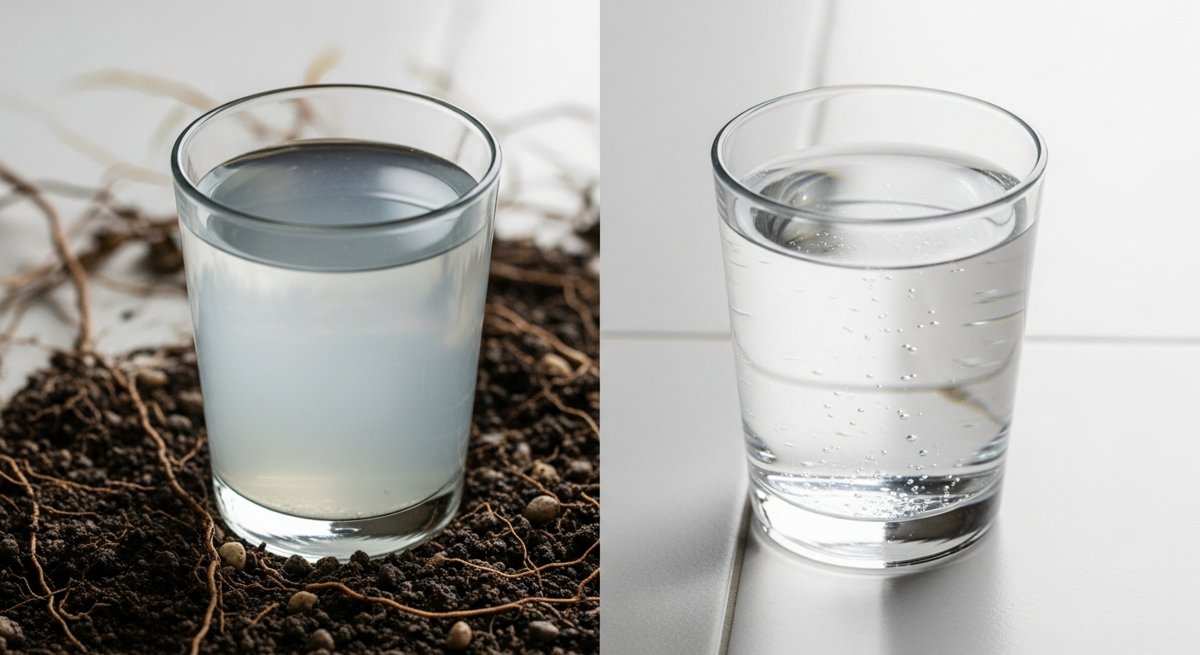
Most people never actually choose between well water and city water. You buy a house, and whatever pipe was already in the ground becomes your water for the next 20 years. You don’t think about it again until the coffee tastes like a swimming pool, the shower glass fogs up with white crust, or the kid’s bathwater comes out faintly orange.
Here’s the thing nobody tells you: both kinds of water need attention. City water isn’t automatically clean, and well water isn’t automatically poison. The difference is who’s responsible — and once you’re on a well, that’s you. So let’s break down what each one actually is, what to test for, and what it really costs to make either one safe to drink. No fear-mongering, no $8,000 sales pitch from a guy in a polo shirt. Just the real picture.
The Core Difference: Who’s the Utility?
City water is treated by a municipal plant, disinfected (usually with chlorine or chloramine), and tested constantly to meet EPA standards before it leaves the plant. The catch: it then travels miles of old pipe — sometimes lead, sometimes cast iron from the 1950s — including the service line running into your house. So your tap water can be worse than what left the plant.
Well water gets zero treatment unless you do it. You are the utility. No one is monitoring it, no one is sending you a quality report, and no one is going to call you when the nitrates climb after a wet spring spreads fertilizer runoff into the aquifer. The upside? No monthly bill and no chemicals you didn’t put there yourself. The downside is the entire rest of this article.
Step One — and It’s Non-Negotiable: Test the Water
You cannot treat what you haven’t measured. This is the single most-skipped step and the one that actually matters. Whether you’re on a well or city, you start with a test.
The cheap home-strip route: A kit like the Health Metric Drinking Water Test Kit runs about $25 and screens for bacteria, lead, pesticides, nitrates, hardness, chlorine, and pH in a few minutes. It’s not lab-grade, but it tells you whether you have a problem worth chasing.
The do-it-right route: Mail a sample to a certified lab. SimpleLab’s Tap Score ($150–$300 depending on panel) sends you a bottle, you ship it back, and you get a real report telling you exactly what’s in your water in parts-per-billion — plus what each contaminant means and how to fix it. For a well, this is worth every penny. Do it once at purchase, then re-test annually (bacteria + nitrates at minimum).
The everyday gauge: A pocket HM Digital TDS-3 meter ($15) reads total dissolved solids instantly. It won’t tell you what’s in the water, but it’s a great way to spot a sudden change and to confirm a filter is actually doing something.
My honest opinion: if you’re on a well and you’ve never sent a real lab sample, stop reading and order one today. I’ve watched people spend thousands on a softener their water didn’t need while ignoring a coliform problem that actually could’ve made them sick. Test first. Always.
City Water: What You’re Actually Dealing With
If you’re on municipal water, your problems are usually narrow and cheap to solve:
- Chlorine / chloramine taste and smell. A simple activated-carbon filter handles this — a pitcher, a fridge line, or an under-sink unit.
- Lead from your own plumbing. Common in homes built before 1986. This is the real risk, and it requires a filter certified to NSF/ANSI 53 for lead — not just any carbon block.
- Hardness. Some cities deliver genuinely hard water. White scale on faucets, spots on glasses, soap that won’t lather.
For most city dwellers, a good under-sink reverse-osmosis unit like the APEC ROES-50 (~$200) at the kitchen tap plus a carbon shower filter covers 90% of complaints. You don’t need to treat your whole house to get clean drinking water.
Well Water: You Are the Treatment Plant
Well water issues run deeper and depend heavily on your geology. The usual suspects:
- Sediment / sand — grit from the aquifer. First thing every well setup needs to knock out.
- Hardness (calcium & magnesium) — scale in pipes and water heaters, the #1 reason wells get a softener.
- Iron & manganese — orange/brown staining on fixtures and laundry.
- Sulfur — the dreaded rotten-egg smell.
- Bacteria (coliform/E. coli) — the one that can actually hurt you. Killed with UV or chlorination.
- Nitrates & pH — runoff and acidity, both common in rural ag country.
A typical well treatment train, in order of water flow: sediment filter → softener (or iron filter) → UV sterilizer → carbon → optional RO at the kitchen. You don’t necessarily need all of it — your lab report tells you which stages to build.
Real gear, real numbers:
- Whole-house sediment + carbon: an iSpring WGB22B 2-stage runs ~$160 and handles grit and chlorine/taste for the whole house.
- Water softener: a Whirlpool WHES40E is ~$600–700 and tames hardness for a typical 1–6 person home.
- UV sterilizer: a VIQUA point-of-entry UV system (~$400–600) kills bacteria without chemicals — essential if your test shows coliform.
The Real Cost Comparison
Everyone asks “which is cheaper?” The answer is: it depends on your time horizon.
| Cost | City Water | Well Water |
|---|---|---|
| Upfront | $0 (connection exists) | $5,000–$15,000 to drill |
| Monthly bill | $40–$80 | $0 (just pump electricity, ~$3–5) |
| Treatment | $200 RO + filters | $1,000–$2,500 full train |
| Ongoing | Filter cartridges ~$60/yr | Salt, filters, UV lamp, pump service ~$200–400/yr |
A well costs a fortune up front and then is nearly free to run. City water is free to start and bleeds you slowly. Over 20 years on a property, a paid-off well usually wins — but only if you stay on top of maintenance. Neglect it and a failed pump or a contaminated casing can cost more than a decade of city bills in one weekend.
The Takeaway
Self-sufficiency isn’t about which pipe you have — it’s about knowing what’s in your water and being able to fix it yourself. The person on city water who’s never tested for lead is more exposed than the well owner who tests annually and runs a proper treatment train.
Your challenge this week: Find out what you’re actually drinking. If you’re on city water, look up your municipality’s annual Consumer Confidence Report (it’s free and public — Google “[your city] CCR water”) and grab a $25 home test for lead. If you’re on a well, order a real lab kit and put “re-test water” on your calendar as a recurring annual reminder.
Twenty-five bucks and twenty minutes. That’s the whole cost of knowing — instead of guessing — what comes out of your tap. Do it this weekend.