

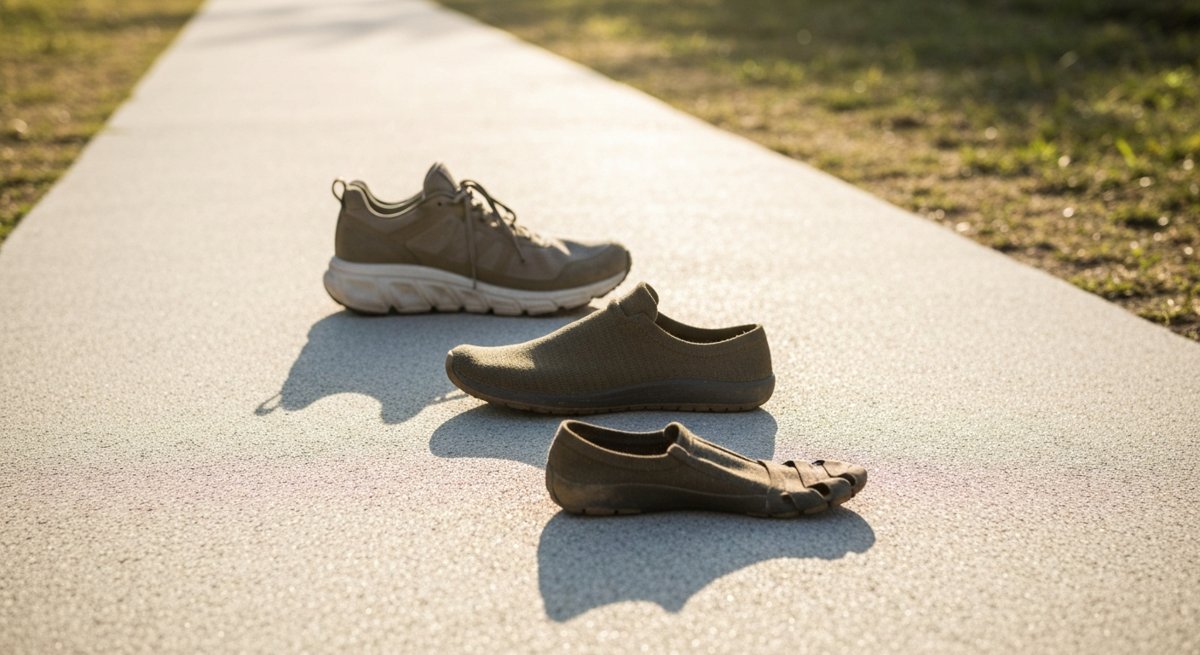
So you read about how modern shoes are wrecking your feet. Or a friend won’t shut up about their Vibrams. Or your knees hurt and the internet told you to go barefoot. Either way — you’re thinking about switching to minimalist shoes, and you want to know how to do it without ending up on crutches.
Good. Because the dirty secret of the minimalist shoe world is that most people who try them get hurt. Not because the shoes are bad. Because they rush.
Your feet have been in supportive, cushioned, heel-elevated shoes since you were a toddler. The muscles, tendons, and connective tissue that should be doing the work have been on vacation for 30-40 years. Then you buy a pair of Xero shoes, go for a 5-mile run on Saturday, and wake up Sunday with a screaming Achilles or a stress fracture in your metatarsal.
This is the guide I wish someone had handed me. It’s a 16-week plan. Yes, sixteen weeks. If that sounds long, you’re exactly the person who needs to read it.
Why You Can’t Just Switch
Three things are happening when you go from a traditional running shoe (10-12mm heel drop, heavy cushioning, motion control) to a minimalist shoe (0mm drop, thin sole, wide toe box):
- Your calves and Achilles take over. A heel-elevated shoe shortens your calf chain. Drop to zero, and suddenly those tissues are stretched longer than they’ve been in decades. They will revolt.
- Your foot muscles wake up. The arch isn’t supposed to be propped up by a shoe — it’s a spring made of 33 joints and 26 bones. Activating that system is like asking a sleeping muscle to do a max effort lift.
- Your gait changes whether you want it to or not. Most heel strikers naturally shift to a midfoot landing in minimalist shoes. That’s a different load pattern on different tissues that aren’t conditioned for it.
The fix isn’t toughness. It’s tissue adaptation time. Bone, tendon, and fascia adapt slowly. Muscle adapts in weeks. Connective tissue takes months. Push muscle past tissue, and tissue tears.
The 16-Week Transition Plan
This assumes you’re a reasonably active adult — you walk, maybe you run a couple times a week, no current injuries. If you’re dealing with plantar fasciitis or an Achilles issue right now, fix that first before starting this.
Weeks 1-4: Wear Them Around the House
That’s it. That’s the whole thing. Put on your new minimalist shoes (or just go barefoot) for an hour or two a day around the house. Cook dinner in them. Watch TV in them. Walk to the mailbox.
What you’re doing: letting the intrinsic foot muscles — the small ones inside your foot that control the arch — start firing again. You’ll notice some foot soreness, especially in the arch and the side of your big toe. That’s normal. That’s the muscles waking up.
Daily homework: 2 minutes of toe spreads (lift all toes, spread them, press them down individually), 2 minutes of calf raises off a step (slow eccentric on the way down).
Weeks 5-8: Short Walks Outside
Now take them outside. Start with 10-15 minute walks. Flat ground. Then build to 30 minutes. Then 45.
By the end of week 8, you should be able to walk a couple miles in minimalist shoes without your calves screaming the next morning. If you can’t — slow down. Repeat week 5 or 6 until you can.
Add to homework: single-leg balance work, 30 seconds per leg, twice a day. Eyes closed if you want to make it harder. Your foot is a sensory organ — it needs to relearn how to read the ground.
Weeks 9-12: Introduce Light Running (If You Run)
If you’re not a runner, skip this and just keep extending your walks, adding hills, and maybe some hiking. You’re done — you can wear minimalist shoes for daily life now.
If you do want to run, the first session is 500 meters. Not 500 yards. Half a kilometer. About 3-5 minutes of running. That’s the whole workout. Cool down by walking another mile.
Build by no more than 10% per week. Run every other day, not back-to-back. Run on grass, dirt, or track for the first month — pavement is the most punishing surface for minimalist running.
Watch your cadence. Most heel strikers run at 160-165 steps per minute. In minimalist shoes you want 170-180. Shorter steps. Land under your hips, not in front of you.
Weeks 13-16: Full Integration
By week 16 you should be doing 80-90% of your daily walking and easy running in minimalist shoes. Keep one pair of traditional shoes around for very long days on hard surfaces, race days, or when you need the cushion. There’s no prize for being a purist.
Warning Signs to Stop
Some discomfort is normal. These aren’t:
- Sharp, localized pain in a bone (top of foot, shin). Could be a stress reaction. Back off for a week. If it persists, get imaging.
- Achilles pain that worsens day-to-day instead of getting better. You’re loading faster than the tendon is adapting.
- Knee pain you didn’t have before. Usually a cadence/form issue. Shorten your stride, increase your steps per minute.
- Plantar fascia pain in the morning. The classic “first steps hurt” sign. Reduce volume by 50% for a week.
Soreness is fine. Stiffness is fine. Sharp pain, asymmetric pain, or pain that’s getting worse over weeks instead of better — that’s a stop sign.
A Few Honest Opinions
You probably don’t need to go fully zero-drop. Going from 12mm to 4mm captures most of the benefit with way less injury risk. Altras, some Topo models, and Lems all live in that 0-4mm range with a wide toe box and moderate cushion. For most people, that’s the sweet spot, not Vibrams.
The wide toe box matters more than the drop. If I could only change one thing about your shoes, it would be the toe box. Modern dress shoes and most running shoes squeeze your forefoot into a shape that doesn’t exist in nature. A wide toe box lets your foot splay on impact — that’s where most of the stability comes from. You can get most of the foot health benefit by just buying shoes that don’t taper.
Not everyone needs to do this. If you’re 55, you’ve been running comfortably in Hokas for a decade, and nothing hurts — you do not have a problem that needs solving. The pain-free system is the right system. This guide is for people whose current setup isn’t working, or who want to build resilience from the ground up.
The Daily Foot Maintenance That Actually Works
Whatever shoe you end up in, these three habits are worth more than any product:
- Walk barefoot at home. The cheapest, most effective foot strength program ever invented. Free. Do it.
- Roll a lacrosse ball or frozen water bottle under your arch for 60 seconds per foot every evening. Especially if you spent the day on hard floors.
- Calf raises off a step — 3 sets of 15, twice a week. Eccentric (slow down) is the key. This is bulletproof Achilles insurance.
The Challenge
For the next 7 days, every minute you’re at home, be barefoot. No house slippers, no flip-flops. Just feet on the floor.
Pay attention. Notice the floor temperature. Notice when you’re walking on the outside of your foot vs. the inside. Notice the tension in your toes when you go up stairs. Most people have spent so long with their feet padded and propped that they don’t realize how much information their feet are designed to give them.
If you can do that one week and your feet feel better — not worse — you’re ready to start week 1 of the transition. If your arches are screaming after two days, that’s your answer: your feet need more rebuilding before any new shoe is going to help.
Either way, you’ll have learned something real about your own body. Which is the point of all of this anyway.
This is Part 4 of the BaseCampGoods Foot Mechanics series. Previous: Your Feet Are Weak (And Your Shoes Did It) and How to Start Running Again Without Destroying Your Knees.