

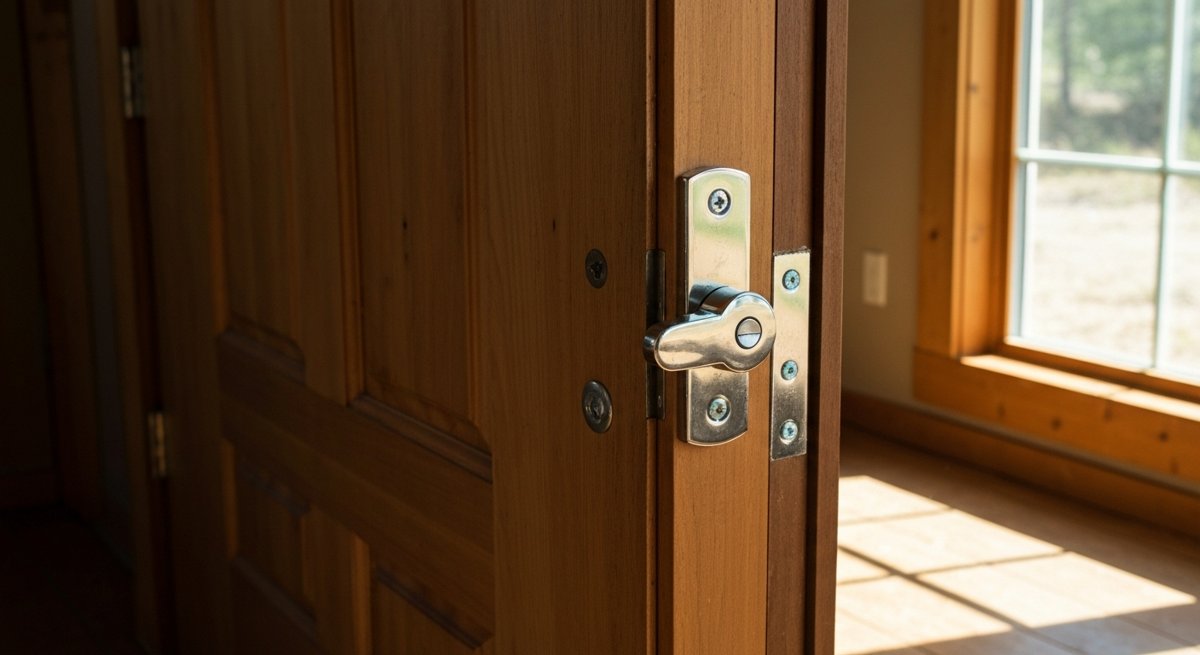
Here’s a stat that should bother you: according to FBI data, over 55% of residential burglaries happen through a door. Not a window. Not through some Mission Impossible ceiling vent. The front door. Sometimes the back door. Sometimes the garage entry door. But it’s almost always a door.
And here’s the kicker — most of those doors fail because of cheap hardware, bad installation, or things the homeowner could have fixed in an afternoon for under $100.
I’m not going to tell you to buy a $3,000 security system. I’m going to show you five upgrades you can do this weekend, most with a drill and a screwdriver, that will make your doors genuinely hard to kick in.
1. Replace Your Strike Plate Screws (Cost: $0–$5)
This is the single most important thing on this list, and it costs almost nothing.
Go look at your front door’s strike plate right now — that metal piece on the door frame where the deadbolt slides in. Pull it off. Look at the screws. I’ll bet you a six-pack they’re 3/4-inch screws that only grip the door jamb — a thin piece of pine that splits like kindling when someone puts a boot to it.
The fix: Replace those screws with 3-inch deck screws. That’s it. Three-inch screws pass through the jamb and bite into the structural framing (the jack stud) behind it. You’re going from a screw gripping half an inch of soft wood to one anchored in the actual structure of your house.
While you’re at it, do the same for your hinges. Most doors come with short hinge screws too. Replace at least one screw per hinge with a 3-inch screw. Now the entire door is anchored to the framing, not just hanging on the trim.
Time: 10 minutes. Difficulty: If you can use a drill, you can do this.
2. Install a Reinforced Strike Plate (Cost: $10–$25)
The stock strike plate that came with your door is a joke. It’s a small rectangle of thin metal held by those pathetic short screws we just talked about.
A reinforced strike plate is a heavy-gauge steel plate, usually 12 to 48 inches long, that distributes the force of a kick across a much larger area of the door frame. Brands like Door Armor, StrikeMaster II, and Prime-Line make versions you can find at any hardware store or online.
Why it matters: A standard deadbolt with a standard strike plate can be kicked in with about 100 pounds of force. With a reinforced plate and 3-inch screws, that number jumps to over 800 pounds. That’s the difference between one kick and “I’m going to find a different house.”
Time: 20 minutes. Difficulty: Easy — it’s just screws and a plate.
3. Add a Door Reinforcement Kit to Your Jamb (Cost: $50–$80)
If you want to go a step further — and I think you should, especially on your front and back doors — get a full door reinforcement kit. These typically include:
- A full-length jamb reinforcement plate (covers the entire lock side of the frame)
- Hinge reinforcement plates (wraps around each hinge)
- A door edge shield (reinforces the area around the deadbolt on the door itself)
Brands like EverPlus, Defender Security, and Door Armor make kits that cover all three. They’re painted to match standard door colors, so they’re barely noticeable once installed.
My opinion: This is the best $60 you’ll spend on home security. Period. Better than cameras. Better than alarm stickers. A camera watches someone break in. A reinforced door stops them.
Time: 45 minutes per door. Difficulty: Moderate — you need to be comfortable with a drill and chisel.
4. Upgrade to a Grade 1 or Grade 2 Deadbolt (Cost: $30–$70)
Deadbolts are graded 1 through 3 by ANSI/BHMA standards. Most builder-grade deadbolts are Grade 3 — the lowest tier. They’re designed to meet building code minimums, not to actually resist forced entry.
What the grades mean:
- Grade 3: Survives 2 strikes in cycle testing. The participation trophy of deadbolts.
- Grade 2: Survives 4 strikes. Significantly stronger construction. Good for residential.
- Grade 1: Survives 10 strikes. Commercial-grade. This is what you want if you’re serious.
Schlage B60N (Grade 1) runs about $40-50. That’s not a big investment for a lock that’s actually built to take a hit. Make sure the bolt throw is at least 1 inch — anything less and it’s not fully engaging the strike plate.
Time: 15 minutes if replacing an existing deadbolt. Difficulty: Easy swap.
5. Don’t Forget the Sliding Door (Cost: $10–$30)
Sliding glass doors are a massive weak point that people consistently ignore. The factory latch on most sliders is basically decorative. Here’s what to do:
- Drop a security bar in the track. A cut piece of broom handle works, but a purpose-built bar like the Master Lock 265D adjusts to fit and won’t roll out. $12.
- Install anti-lift pins. Drill a small hole at a downward angle through the inside frame into the outside frame (when the door is closed). Drop a nail or pin in. This prevents someone from lifting the door off its track. $0.
- Add a secondary foot lock. These screw into the bottom track and flip up to block the door from sliding. Cheap, effective, and adds a second point of resistance.
Time: 15 minutes. Difficulty: Dead simple.
The Uncomfortable Truth
Most burglaries are crimes of opportunity. The guy isn’t picking your lock. He’s not disabling your alarm. He’s kicking your door once, hard, and he’s in. The whole thing takes 10 seconds.
Every upgrade on this list makes that kick harder — or impossible. And the total cost for all five? Somewhere between $50 and $200 depending on how many doors you’re hardening. That’s less than one month of a monitored alarm service that does nothing to physically stop entry.
I’m not saying don’t get cameras or an alarm. I’m saying those are layer two. Layer one is making your doors actually hard to get through. Physical security first, electronic security second.
Your Weekend Challenge
Right now — today — go pull the strike plate off your front door and look at those screws. If they’re short, you know what to do. That one upgrade alone makes your door dramatically harder to force open, and it takes less time than scrolling through your phone.
Then work your way down this list. One door per weekend if you want to take it slow. By the end of the month, every entry point in your home will be genuinely hardened — not “security sticker” hardened, but actually hardened.
Stop decorating your doors with security theater. Reinforce them.