

Let me save you a weekend of YouTube rabbit holes and three hours on the phone with a sales rep who calls himself a “solar consultant.” Here’s what a real off-grid or backup solar setup actually costs in 2026 — broken down by what you’re trying to do, what gear you actually need, and where people waste money.
Spoiler: it’s cheaper than it was five years ago. It’s also more confusing, because the market is flooded with all-in-one units that range from genuinely good to garbage in a clever box. I’ll tell you which is which.
First: What Are You Actually Trying to Do?
99% of bad solar decisions happen because someone bought the wrong category of system. There are really only four:
- Tier 1 — Phone/Light Backup ($150–$400). Keep phones charged, run a fan, power a couple LED lights during a short outage. A small power station + one folding panel.
- Tier 2 — Fridge + Essentials Backup ($800–$2,500). Run a fridge, a CPAP, internet router, charge tools, lights for a few days. Mid-size power station (1,500–3,000Wh) plus 200–400W of panels.
- Tier 3 — Whole-Home Backup ($6,000–$15,000). Tied to your panel via transfer switch. Runs most of the house through outages. Larger battery bank, inverter, maybe rooftop solar.
- Tier 4 — True Off-Grid ($20,000+). No utility connection. Roof or ground array, battery bank, generator backup, the works.
If you don’t know which tier you need, you’re Tier 2. Almost everyone reading this is Tier 2. That’s where the real value lives — meaningful backup power, no electrician required, portable enough to take camping. Let’s break that down.
The Tier 2 Starter System (What Most People Should Build)
Here’s a real-world setup that handles a multi-day outage, runs a fridge, keeps phones and laptops alive, and powers a few lights and a fan. Total cost: about $1,400–$1,800 in 2026.
Component 1: A Power Station with LiFePO4 Batteries — $900–$1,200
This is the brain. It’s the battery, the inverter, the charge controller, and the outlets all in one box. Non-negotiable: it must be LiFePO4 (lithium iron phosphate), not standard lithium-ion. LiFePO4 lasts 3,000–6,000 cycles vs 500–1,000 for regular Li-ion, doesn’t catch fire if punctured, and handles temperature extremes way better. Brands I’d actually buy: EcoFlow Delta 2, Bluetti AC180, Anker Solix C1000, Jackery Explorer 1000 v2. Aim for at least 1,000Wh of capacity and 1,500W of continuous output. That’ll run a typical fridge plus a few small loads.
Component 2: Solar Panels — $300–$500
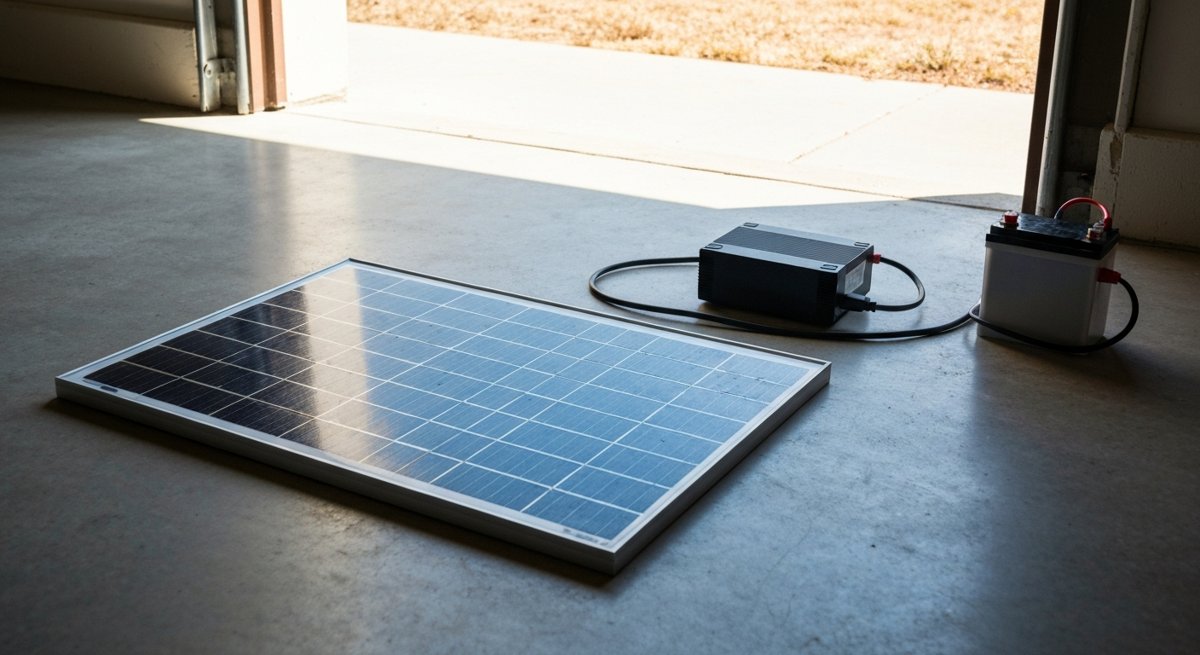
200–400W of foldable or rigid panels. Foldable is more versatile (you can chase the sun, pack them away), but rigid panels are cheaper per watt if you have a permanent spot. Two 200W foldable panels in parallel will give you a real-world 800–1,200Wh of charging per sunny day — enough to keep that 1,000Wh station topped off if you’re running modest loads.
Component 3: A Good Extension Cord and Heavy-Duty Outlet Strip — $50
Sounds boring, matters a lot. You need at least a 12-gauge outdoor extension cord to run from your power station (probably in the garage or by a window) to your fridge. Cheap 16-gauge cords will sag voltage and trip your inverter on startup surges.
Component 4: A Kill-A-Watt Meter — $30
Buy this before you buy a power station. Plug your fridge into it for 24 hours and read the actual daily watt-hours. Same for any other appliance you want to back up. Now you know exactly what size system you need. This $30 tool will save you from buying double the system you actually need — or half.
The Math Nobody Shows You
Here’s the formula that demystifies the whole thing:
Modern fridge: ~100W average, runs ~8 hrs/day cycling = 800 Wh/day
CPAP: 40W × 8 hrs = 320 Wh/night
Router + modem: 15W × 24 hrs = 360 Wh/day
Phones/laptop charging: ~150 Wh/day
3 LED lights: 10W × 5 hrs each = 150 Wh/day
Total essentials: ~1,800 Wh/day
So a 1,000Wh battery alone won’t last a full day of essentials. But pair it with 400W of solar in decent sun, and you’re generating 1,500–2,000 Wh/day of recharge. Now you’re sustainable. That’s why both halves of the system matter — battery alone is just a backup. Battery + panels is power independence.
Where People Waste Money
- Buying gas-generator-sized systems for fridge-sized needs. You don’t need a 5,000Wh monster to ride out a 36-hour storm.
- Cheap lead-acid setups. The math used to favor lead-acid on price. It doesn’t anymore. LiFePO4 is now cheaper over its lifetime, weighs a third as much, and doesn’t need to be vented.
- Permanent rooftop installs for backup-only use. If you just want emergency power, don’t drill into your roof. A portable system is more flexible, moves with you, and works during a grid-down event without a special transfer switch.
- Generic Amazon “1500W” panels. If a 200W panel costs $80, it’s not a 200W panel. Real-world output from no-name panels is often 40–60% of the sticker number.
- Ignoring the inverter rating. A 1,000W inverter cannot start a fridge. Compressors have a startup surge 3–5x running watts. You need at least 1,500W continuous, with 3,000W surge.
My Honest Opinion on All-in-One Power Stations
I used to be a “build your own with separate components” snob. I’m not anymore. The modern all-in-one units are genuinely good — they pack a proper LiFePO4 battery, a pure sine wave inverter, an MPPT charge controller, and a battery management system into one box for less than you could build it for in 2026. Unless you’re going Tier 3 or Tier 4, just buy the all-in-one. Skip the 3 weekends of wiring, fuse-sizing, and second-guessing.
The only reason to DIY is if (a) you want a 5,000+ Wh bank, or (b) you genuinely enjoy this stuff. Both are fine. Just be honest with yourself.
A Word on Tax Credits
The federal Residential Clean Energy Credit currently covers 30% of the cost of solar systems — but only if they’re permanently installed on your home. Portable power stations don’t qualify. If you’re going Tier 3 (whole-home with rooftop), the 30% credit changes the math substantially. A $12,000 system effectively costs $8,400. Talk to a CPA before pulling the trigger, and don’t trust the installer’s word on what qualifies.
The Honest Truth About Payback Periods
Solar salespeople love to talk about “payback in 7 years.” For a backup-only Tier 2 system, the payback isn’t in dollars saved on your power bill — it’s in not losing $400 of fridge contents during an outage, being able to work during a multi-day storm, and not paying $1,500 for a generator + fuel + maintenance over 10 years. Frame it that way and a $1,500 system pays for itself the first time the grid goes down for more than 24 hours.
A Tier 3 whole-home install with grid sell-back? Real payback in some states is 8–12 years. In states with cheap power and no net metering, more like 18–25 years. Run the numbers for your zip code before anyone tries to sell you anything.
Your Challenge This Weekend
Do these three things before you buy anything:
- Buy a $30 Kill-A-Watt meter. Measure your fridge for 24 hours. Write down the kWh.
- Add up the daily Wh of every appliance you’d actually want during an outage. Be honest — you don’t need to run a hair dryer.
- Multiply that total by 1.5 to size your battery (gives margin for cloudy days and aging cells). That’s your target Wh.
Now you know what to buy. Not what a YouTube affiliate is pushing. Not what a salesperson commissioned on margin recommends. What you actually need.
Solar isn’t magic. It’s just math and decent equipment. Do the math, buy decent equipment, and you’ll never panic during a thunderstorm again.
Looking for gear that actually holds up? Check the BaseCampGoods shop for tested EDC and preparedness gear we’d put in our own kits.
Solar is one system; a self-reliant property runs on several. For the complete DIY blueprint — power, water, food, and storage, with no one upselling you — The Self-Sufficient Backyard is worth the read.